Both / Contract Protection / DUFFY Take
Deals don’t fall apart because of price. They fall apart because someone missed a deadline, a disclosure, or a contingency. Here’s the checklist most agents don’t use.
Deals don’t fall apart because of price. They fall apart because someone missed a deadline, a disclosure, or a contingency. Here’s the checklist most agents don’t use.
Almost every transaction that dies in escrow looks the same in retrospect. There was a deadline that nobody calendared. A disclosure form somebody forgot to send. A contingency that lapsed because everyone assumed someone else was watching it. A title issue that should have been flagged in week one but didn’t surface until week four.
By the time the deal blows up, the parties are pointing at each other. The buyer thinks the seller acted in bad faith. The seller thinks the buyer was trying to escape. The agents shrug. The earnest money goes somewhere. And the lesson — that the contract was the actual problem, not the people — gets lost in the wreckage.
After tens of thousands of Atlanta closings, we have a pretty clear view of where deals actually die. It is almost never the price. It is almost always the details. Here is the playbook for what to watch.
The 47 Deadlines in a Typical Contract
A standard Georgia residential purchase contract has somewhere between 30 and 50 deadlines, depending on the addenda attached. Most parties to the contract — buyers, sellers, and frankly some agents — could not list more than 5 or 6 of them off the top of their head.
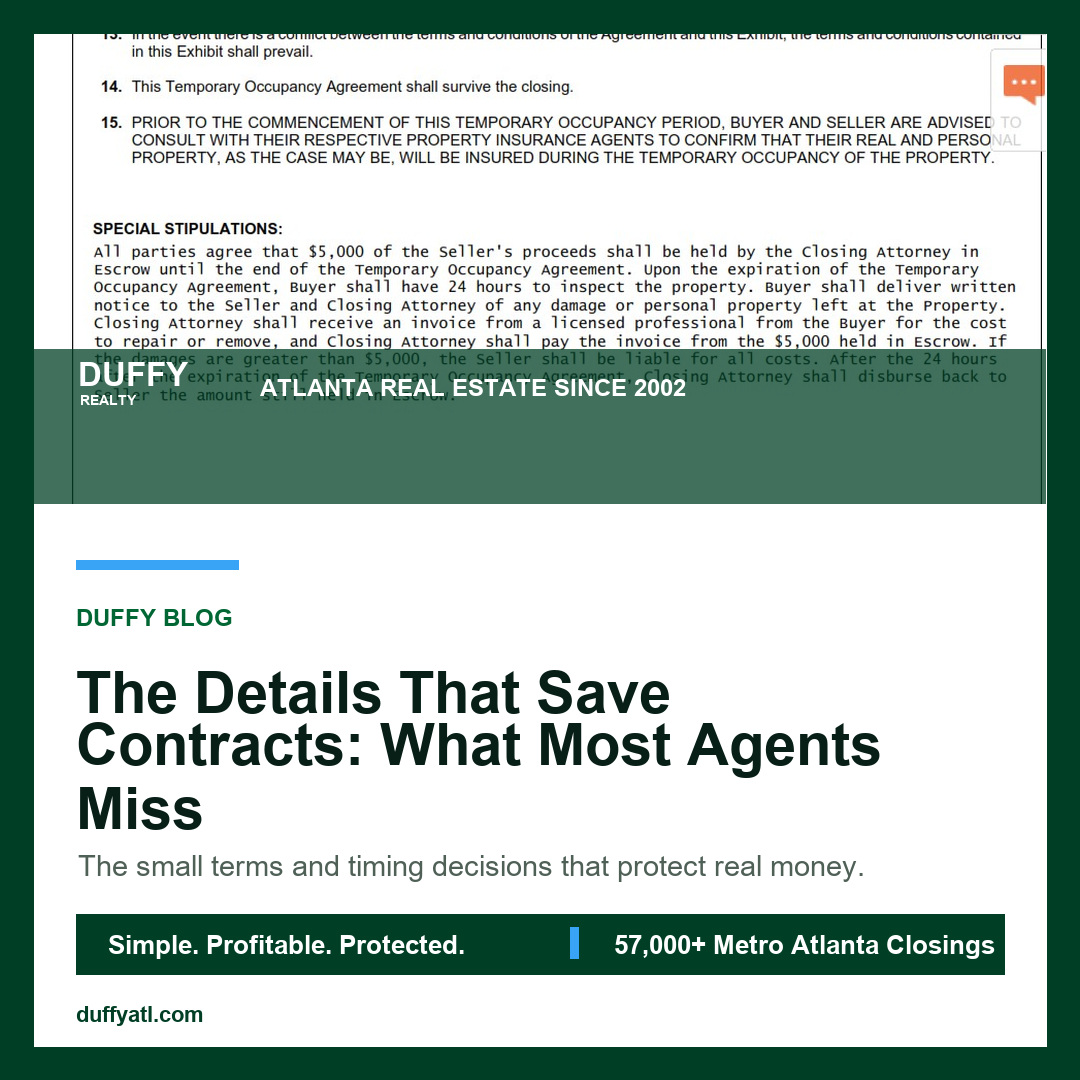
The deadlines that matter most include: due diligence start and end, financing application deadline, financing approval deadline, appraisal contingency deadline, title commitment delivery, survey delivery, association documents delivery and review period, repair request deadline, repair completion deadline, inspection objection deadline, walk-through scheduling, closing date, and possession date.
DUFFY makes this simpler.
If you are selling, this is where DUFFY gets useful: pricing, value details, syndication, negotiation, contract review, and a 1% listing fee.
Each deadline has a consequence if missed. Some forfeit earnest money. Some void contingencies. Some shift legal risk from one party to the other. A few create automatic terminations that surprise everyone. A buyer who misses the financing approval deadline by 24 hours can lose their right to terminate over a financing problem that arises a week later.
DUFFY uses a proprietary protection timeline on every transaction that tracks each deadline by hour, not by day. We do not let dates slip. The discipline of watching the calendar is unglamorous and decisive.
Due Diligence Landmines
Georgia’s due diligence period — typically 7 to 14 days — is where most deals reveal whether they will close. It is also where most contract mistakes happen.
The first landmine: assuming due diligence is just inspection time. It isn’t. Due diligence covers the entire investigation period, including title review, association documents, survey review, insurance availability, and any seller-provided disclosures. Buyers who treat it as inspection-only routinely miss issues that surface too late to act on.
The second landmine: the inspection objection process. Many buyers don’t realize that submitting an inspection objection list is itself a contractual act with deadlines and consequences. Submitting too late forfeits the right to object. Submitting too aggressively can prompt a seller to terminate. Submitting without a clear plan for what happens if the seller refuses to repair leaves the buyer scrambling.
The third landmine: the silent expiration. If due diligence ends without the buyer formally exercising their right to terminate, the contingency dissolves. Many buyers think the deadline is something they have to actively engage with. They don’t. It will pass automatically — and once it does, escape options narrow dramatically.
Financing + Appraisal Traps
Financing contingencies are written narrowly, and most buyers don’t realize how narrow until the trap closes.
A typical financing contingency requires the buyer to apply for a loan within a specified number of days, secure conditional approval by another deadline, and clear all financing conditions by yet another. Each step has its own clock. A buyer who got pre-approved before writing the offer sometimes thinks they have already satisfied the contingency. They have not. The contingency runs against the specific loan for the specific property — not against the buyer’s general financial fitness.
Appraisal traps are a separate category. The standard purchase contract handles appraisal in one of three ways: as a financing contingency component (the loan must appraise), as a standalone appraisal contingency (the buyer can terminate or renegotiate if it comes in low), or as waived (the buyer takes the risk). Buyers who waive appraisal in a competitive offer to win the deal are taking on a real exposure — they may need to bring cash to closing if the appraisal lands below contract price. Sellers should understand the strength of an appraisal-waived offer is real, but it shifts no risk onto the seller; the risk all stays with the buyer.
DUFFY walks every buyer through their specific contingency language before signing. Generic explanations of "how financing works" aren’t enough. The contract you sign is the contract that governs you.
Title + Survey Issues Nobody Catches
Title issues are the silent killer of Atlanta transactions. They surface late, they take time to resolve, and they almost always require legal work before closing.
The most common title problems we see include: undisclosed liens (often from prior unpaid contractor work), boundary disputes that show up on the survey, easements that the seller forgot to disclose, judgments against the seller that attached to the property, missing signatures on prior deeds in the chain of title, and association liens for unpaid dues.
Each of these can be cleared. Most are cleared every week in transactions that close on time. The issue is timing — if the title commitment comes back in week three of escrow with a problem, you have to discover it, communicate it, plan a resolution, execute the resolution, and confirm clearance, all before closing. The math is tight, and missed by a single day, the closing slides.
Surveys present a parallel risk. A current survey often reveals issues — encroachments, fence-line problems, easement violations — that appear nowhere in the title work but that any rational buyer should know about before closing. Sellers who haven’t ordered a current survey sometimes learn about a 4-foot encroachment from their neighbor’s shed during the buyer’s diligence. By then, fixing it is somebody’s expensive problem.
DUFFY’s Loophole Defense System
We protect clients from contract problems with a system, not with luck. Our protection timeline is the operational backbone of every DUFFY transaction. It tracks each deadline against the specific contract, flags upcoming risks before they arrive, escalates issues to the right specialist on our team, and documents every communication.
The system covers a few specific commitments to every client. We confirm receipt and review of every title document, survey, association packet, and disclosure within 24 hours of delivery. We watch every contingency expiration on a separate calendar from the closing date itself. We pre-flag every standard issue that the contract structure exposes the client to, before it becomes a live problem. And we communicate proactively — before a deadline, not after.
This is part of why our model works at lower commission while delivering equal or better protection: we engineered the process to remove inefficiency, not service. You can read more about how this fits into how your sale is managed at DUFFY and our DUFFY contract-to-closing assistance.
Contracts don’t kill deals. Inattention to contracts kills deals. The cost of attention, when it is built into the system, is far smaller than the cost of a deal that dies in week five over a missed deadline in week one.
Quick Answers
What is a due diligence period in Georgia?
Georgia’s due diligence period is a contractually defined window — typically 7 to 14 days from binding agreement — during which a buyer can investigate the property and terminate the contract for almost any reason without forfeiting earnest money. It covers inspection, title review, survey, association documents, financing investigation, and any other due diligence the buyer deems necessary. Once the period expires, the buyer’s options to terminate narrow significantly.
What happens if I miss a contract deadline?
Consequences vary by deadline. Missing a contingency deadline often dissolves the contingency, meaning the buyer loses the right to terminate based on that issue. Missing the financing application or approval deadline can shift earnest money risk to the buyer. Missing the closing date can put the entire transaction in default unless an extension is negotiated and signed. The contract specifies the consequence for each deadline — and they are enforced literally.
Who is responsible for contract errors?
The party signing the contract is bound by it, regardless of whether their agent caught an error. This is why agent diligence matters. If a buyer’s agent fails to flag a missed deadline, the buyer still bears the consequence with the seller, even if the buyer may have a separate claim against their agent. The most reliable protection is a brokerage with a structured deadline-tracking system — not just an attentive individual agent.
Keep inspecting the DUFFY standard.
Before you pay more, inspect what DUFFY actually built: protection, proof, strategy, and a simpler path from first question to closing.
Quick Answers
What is a due diligence period in Georgia?
In Georgia, due diligence is the period when the buyer investigates the property and can often terminate under the contract terms. Dates, deadlines, and written terms matter.
What happens if I miss a contract deadline?
Missing a contract deadline can cost leverage, money, rights, or even the deal. DUFFY uses protection timelines and contract review to keep dates from becoming expensive surprises.
Who is responsible for contract errors?
The parties sign the contract, but agents and brokers should help catch mistakes before they become expensive. DUFFY uses multiple contract reviews because one pass is not enough.
Next week: keep going.
DUFFY’s blog path is built to make sellers and buyers sharper each week. Simple, easy, protected.