Buyers / Commission Sharing / DUFFY Take
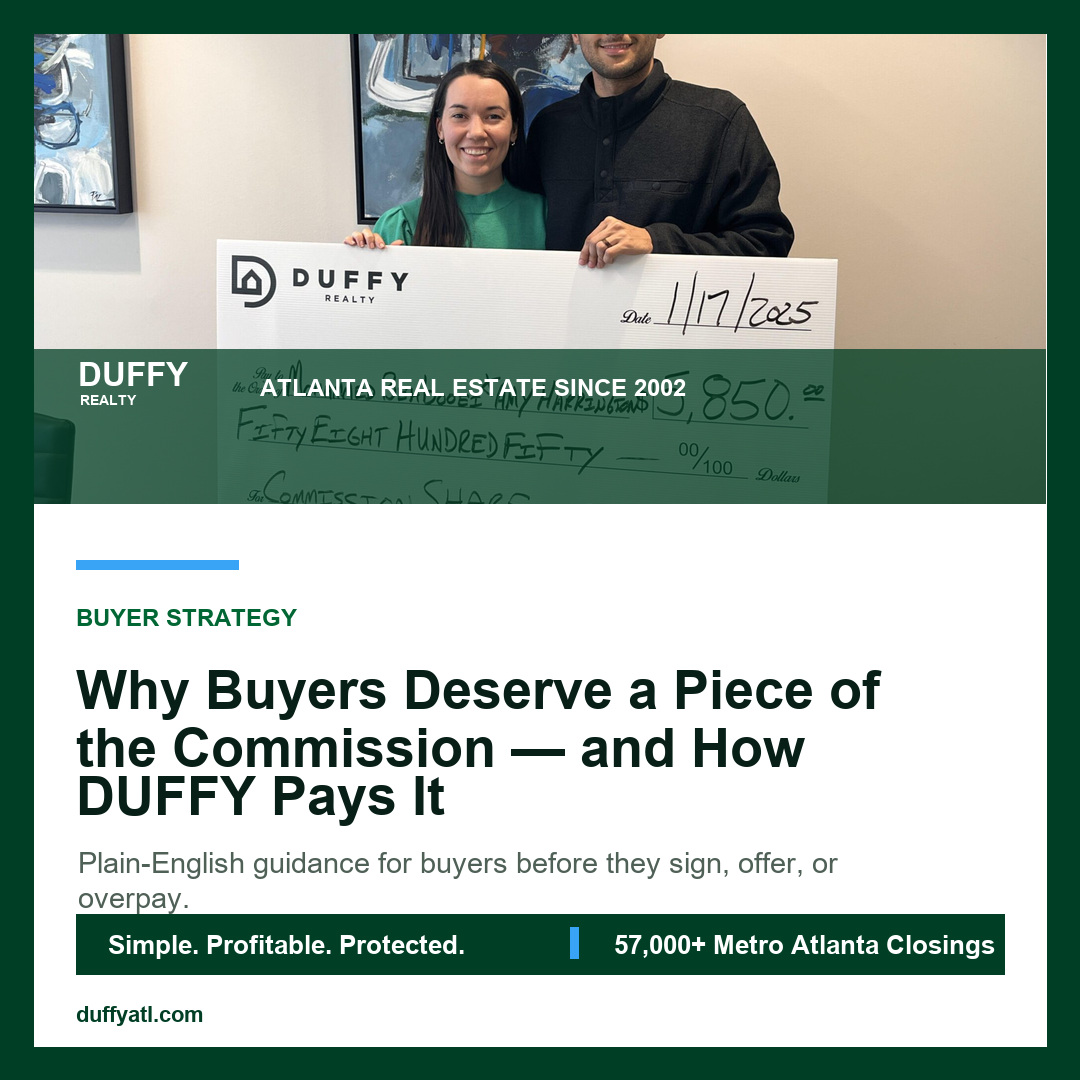
You found the house. You drove to it. You fell in love with it. Why does the agent get 100% of the compensation? At DUFFY, they don’t.
You found the house. You drove to it. You fell in love with it. Why does the agent get 100% of the compensation? At DUFFY, they don’t.
Here is a question almost no buyer ever asks out loud: what exactly is the buyer’s agent doing that justifies a check for $15,000 at closing?
It is a fair question. It used to have a different answer. In 1995, before Zillow, before Realtor.com, before the MLS was searchable from your phone, a buyer’s agent was the gatekeeper to inventory. They knew which houses were for sale. They drove you to them. They controlled the discovery process.
That world is gone. Modern buyers find their own homes. They search online for weeks before they ever talk to an agent. They drive past houses they like. They build a shortlist. By the time they call an agent, the discovery work is largely done.
And yet the compensation model still pretends nothing has changed. The buyer’s agent still collects the same percentage they collected in 1995, even though the buyer did half the job. At DUFFY, we built the model to recognize that — and to share the savings with the buyers who actually do the work.
How Traditional Buyer Commissions Work
In a traditional Atlanta transaction, the seller agrees to pay a total commission — historically around 6%, often split 3% to the listing agent and 3% to the buyer’s agent. After the 2024 NAR settlement, the mechanics shifted slightly, but the practical reality on most Atlanta deals still resembles the old structure: the seller pays a buyer’s agent commission, and the buyer’s agent collects it in full at closing.
DUFFY makes this simpler.
If you are buying, the old 3% autopilot agreement is not your only option. DUFFY helps you get in fast, understand the money, and stay protected.
On a $500,000 home, that is $15,000 going to the buyer’s agent. On a $750,000 home, $22,500. On a $1,000,000 home, $30,000.
Now ask yourself what that buyer’s agent did to earn that figure. They opened a few doors. They submitted an offer. They forwarded paperwork. They attended the inspection. They showed up at closing. Important work — but not work that scales with the home’s price. The buyer’s agent on a $300,000 starter home does roughly the same job as the buyer’s agent on a $900,000 luxury listing. The pay is triple. The labor isn’t.
What Buyers Actually Do in the Process
Modern buyers do the heaviest lifting in the discovery phase, and that work used to be the agent’s. Today’s buyer typically:
Searches online for weeks or months across multiple portals — Zillow, Realtor.com, Redfin, the MLS direct.
Sets up custom alerts and tracks new listings in real time.
Drives by neighborhoods to evaluate fit, schools, commute, and feel.
Builds and refines a shortlist of homes worth seeing in person.
Researches school districts, crime data, walkability, and resale trends.
Compares price-per-square-foot trends across submarkets.
Reads listing remarks, inspection clues, and price history before scheduling a tour.
By the time a modern buyer requests a showing, they have already done what a 1995 agent would have spent weeks doing on the buyer’s behalf. The agent’s role has shifted — from finder to closer. The agent now adds value primarily on negotiation, contract management, inspection navigation, and getting the deal across the finish line.
That work matters. It is real expertise, and it deserves real compensation. But it does not deserve 100% of the commission when the buyer did 50% of the job.
The DUFFY Math: 1.5% vs. 3%
Here is how it works at DUFFY. When you buy a home with us as your buyer’s agent, we collect the buyer’s agent commission negotiated in the deal — and we share up to half of it with you, capped at 1.5% of the purchase price, paid as a buyer client incentive at closing.
On a $500,000 home, that is up to $7,500 back to you. On a $750,000 home, up to $11,250. On a $1,000,000 home, up to $15,000.
We still get paid for the work we do — negotiation, contract protection, deadline management, inspection guidance, closing coordination. But we don’t pretend the buyer wasn’t half the labor. The savings flow back where they belong: to you, the buyer who found the house.
The exact rebate depends on how the commission is structured in your specific transaction and how the buyer’s agent compensation is set up in the deal. We walk you through the math before you write the offer, so there are no surprises at closing.
Real Rebate Examples
We have written enough of these checks over 24 years that the pattern is familiar. A buyer finds a house. We help them write the offer, navigate the inspection, manage the financing timeline, and get to the closing table. At the closing table, we share the commission.
Different deals produce different rebate amounts. A buyer on a $425,000 starter home in Cobb County might receive a few thousand back. A buyer on a $1.2M renovation in Buckhead receives substantially more. A first-time buyer using rebate funds to cover closing costs and reduce the mortgage need is a recurring scenario — and it changes what they can afford.
Real DUFFY clients regularly use the rebate to cover closing costs entirely, fund moving expenses, build a renovation budget, or simply put money back in savings. It is not theoretical. It is a check or credit at closing. We have published the program details on our DUFFY Buyer Client Incentive page if you want the formal terms — and our company history page on what happened to DUFFY Realty walks through how the model evolved.
How to Claim Yours
There are three things buyers need to know to actually receive a DUFFY rebate.
First, you must engage DUFFY as your buyer’s agent before you write the offer. We cannot retroactively claim a buyer’s agent commission on a transaction where another agent was already representing you. The arrangement is set up at the start, not at closing.
Second, the rebate amount depends on the buyer’s agent commission offered in the deal. In a traditional listing where the seller is offering a competitive buyer’s agent commission, the math works out cleanly. In situations where the buyer’s agent commission is unusually low or where the buyer is paying their agent directly, the rebate structure adjusts accordingly — and we explain that openly before you commit.
Third, the rebate is paid at closing as a credit, a check, or a settlement statement adjustment, depending on what the lender allows for your specific loan type. For most conventional loans this is straightforward. For some FHA and VA loan structures, the lender may impose limits on credits — but in nearly every scenario, there is a path to deliver the savings.
The point is this: you are doing the work modern buyers do. You should share in the savings. That is not a gimmick or a discount. It is honest compensation math.
Quick Answers
Is a buyer commission rebate legal in Georgia?
Yes. Buyer commission rebates are legal in Georgia and have been for years. Georgia is one of approximately 40 states that permit the practice. The rebate is treated as a reduction in commission or a credit at closing, and is fully disclosed on the closing settlement statement. Some loan programs, particularly certain FHA and VA structures, have limits on how the rebate can be applied — but the rebate itself is legal.
How much can I get back as a buyer?
At DUFFY, buyer clients receive up to 1.5% of the purchase price back at closing, depending on how the buyer’s agent commission is structured in the specific deal. On a $500,000 home, that is up to $7,500. The exact amount is calculated based on the commission paid by the seller and the structure of the transaction, and is disclosed in writing before you write the offer.
Do I pay taxes on a commission rebate?
Generally, no. The IRS treats a buyer commission rebate as a reduction in the purchase price of the home rather than as taxable income. This means most buyers do not owe income tax on the rebate. Because individual tax situations vary, we always recommend confirming with your tax professional — but the typical outcome is a non-taxable purchase price adjustment.
Keep inspecting the DUFFY standard.
Before you pay more, inspect what DUFFY actually built: protection, proof, strategy, and a simpler path from first question to closing.
Quick Answers
Is a buyer commission rebate legal in Georgia?
Buyer commission rebates and incentives can be allowed in Georgia when handled properly through the transaction. DUFFY has built its buyer model around sharing compensation because buyers now do much of the search work.
How much can I get back as a buyer?
It depends on the seller-paid compensation, the purchase price, lender rules, and the terms of your buyer representation. DUFFY’s buyer representation fee is 1.5%, not the old automatic 3% model.
Do I pay taxes on a commission rebate?
Ask your CPA for tax advice. In many transactions, buyer incentives are treated as part of the purchase economics, but your own tax situation matters.
Next week: keep going.
DUFFY’s blog path is built to make sellers and buyers sharper each week. Simple, easy, protected.