Buyers / Contract Protection / DUFFY Take
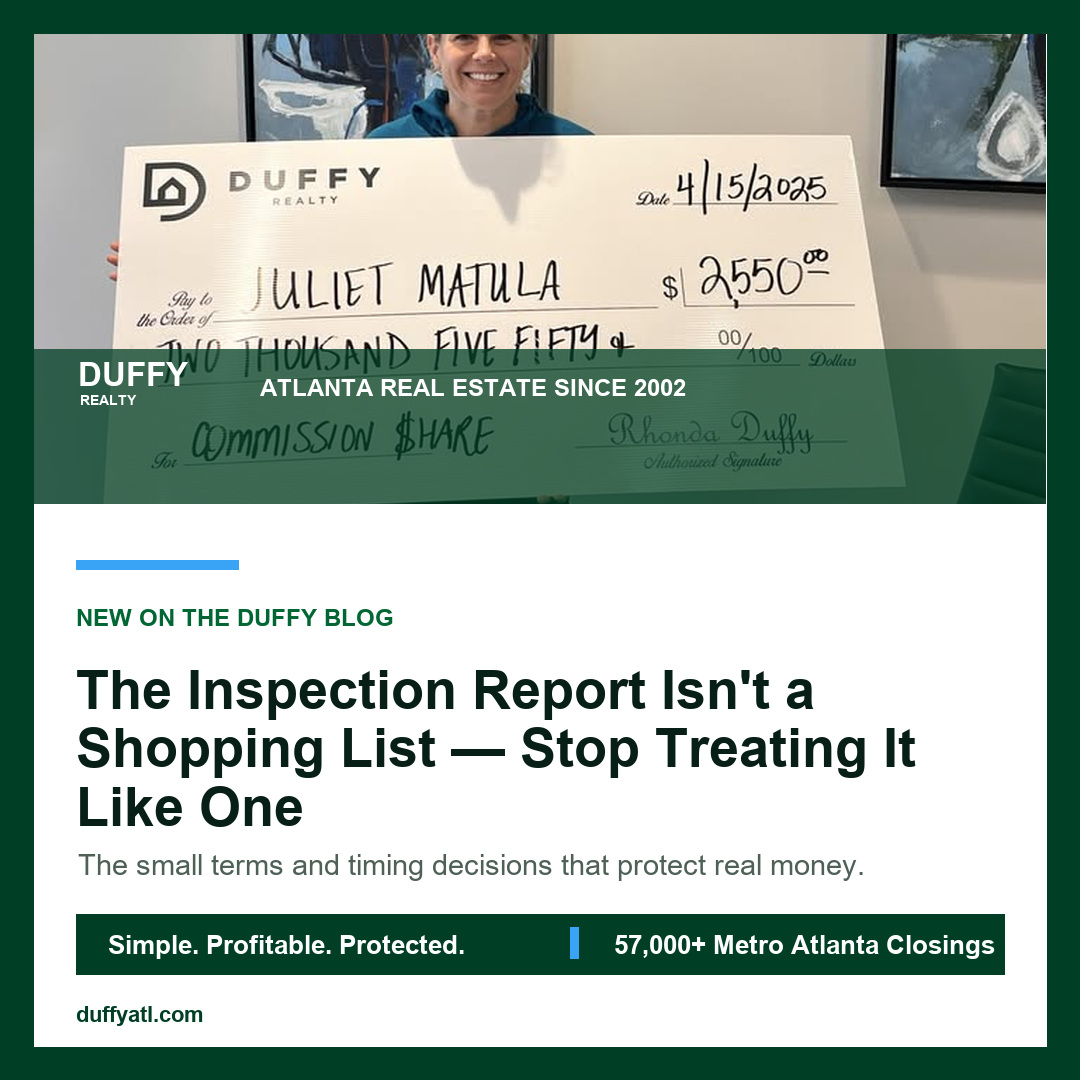
Buyers see a 47-page inspection report and panic-negotiate everything. Sellers see it and dig in. Both lose. Here’s how to actually use an inspection report.

Buyers see a 47-page inspection report and panic-negotiate everything. Sellers see it and dig in. Both lose. Here’s how to actually use an inspection report.
The home inspection report is the single most misunderstood document in residential real estate. The buyer reads 47 pages of findings — half of them in alarming language — and concludes the house is falling apart. The seller reads the same 47 pages and concludes the buyer is unreasonable. Neither is right, and both reactions kill deals that didn’t need to die.
Inspection reports are exhaustive by design. The inspector’s job is to flag everything that could conceivably matter, no matter how minor, to protect themselves from future liability. A typical Atlanta inspection report will identify 50 to 100 "items" on a normal house in normal condition. The report doesn’t tell you which ones matter. It just lists them.
Reading the report correctly — and using it strategically — separates buyers who close on time and at fair terms from buyers who lose homes over $400 worth of caulking. Here is the framework.
What Inspectors Flag (and Why Some of It Doesn’t Matter)
An inspection report contains four broad categories of findings. Each requires a different response, and treating them all the same is the buyer’s most common mistake.
The first category is informational. The inspector notes the age of the roof, the presence of certain wiring types, the location of shutoffs. These items aren’t problems — they’re documentation. Buyers who try to negotiate these are essentially asking for credits because the house exists.
DUFFY makes this simpler.
If you are selling, this is where DUFFY gets useful: pricing, value details, syndication, negotiation, contract review, and a 1% listing fee.
The second category is maintenance. Caulking that needs refreshing, gutters that need cleaning, filters that need changing, paint that needs touching up. These are normal homeownership items. They aren’t the seller’s problem — they’re the buyer’s first weekend in the new house.
The third category is minor repair. A loose railing, a sticking door, a broken light fixture, a small drywall crack. These genuinely need fixing, but the cost is usually under a few hundred dollars per item. Buyers can ask for these, but stacking too many of them into a request reads as petty and triggers seller resistance.
The fourth category is significant. Roof problems, foundation movement, electrical hazards, HVAC failures, water intrusion, structural concerns. These are the items that genuinely change the deal economics. These are the only items where buyers should be willing to walk away or where sellers should expect to negotiate seriously.
The mistake most buyers make is bringing every item from all four categories into the negotiation as if they’re equivalent. They aren’t.
The Big 5 That Do Matter
Here are the five categories of inspection findings that genuinely warrant strong negotiation or, in extreme cases, walking away from the deal:
Structural issues — foundation movement, beam or joist problems, settling beyond normal range. Cost to fix: $5,000 to $50,000+. Always investigate further with a structural engineer before deciding.
Roof problems — active leaks, end-of-life roofing, significant damage. Cost to fix: $8,000 to $25,000 for replacement on most Atlanta homes.
Major systems — HVAC at end of life, water heater failures, panel issues, plumbing problems beyond minor leaks. Cost to fix: $3,000 to $15,000 per system.
Water intrusion — basement moisture, crawl space issues, drainage problems, evidence of past flooding. Cost to fix: $2,000 to $30,000+ depending on cause and scope.
Safety issues — electrical hazards, gas concerns, asbestos or lead findings, mold in significant quantities. Cost varies widely, but these can’t be ignored regardless of cost.
Anything outside these five categories is either maintenance, minor repair, or informational — and should be treated proportionally in negotiations. A buyer who walks into a negotiation with a 20-item list of small repairs alongside a real structural finding will dilute the urgency of the structural finding and lose leverage where it actually matters.
How to Prioritize Your Asks
The most effective inspection negotiations follow a simple structure. Identify the 1 to 3 truly significant findings — items from the Big 5 above. Calculate the actual cost or risk of each. Build the negotiation around those items, with everything else explicitly bundled or set aside.
Here is what a strong inspection request looks like: "We’ve reviewed the inspection. The main concerns are the HVAC system at end of life, which the inspector estimates needs replacement within 2 years, and the evidence of past water intrusion in the basement. We’re asking for either replacement of the HVAC and remediation of the basement issue, or a credit of $X toward closing to address them. We are not making any other requests."
That message reads as serious, focused, and worth engaging. The seller and listing agent immediately understand what the deal is about. Negotiation can proceed.
Compare to: "We have 23 items from the inspection report we’d like addressed." That message reads as buyer’s remorse expressed through a checklist. The seller’s instinct is to refuse everything, and the negotiation collapses into mutual frustration.
Less is more. Strategic, not exhaustive.
When to Walk, When to Credit, When to Let Go
There are three possible negotiation outcomes for any inspection finding, and choosing the right one matters.
Walk away when the findings reveal something the home cannot reasonably be made worth your contract price. A failing foundation on a $400,000 home where remediation will cost $80,000 may not be worth fixing — and the seller may not be willing to absorb the cost. Sometimes the right move is to terminate, recover earnest money, and find a different home. Buyers who are afraid to walk away always overpay.
Take a credit when the issue is fixable but you’d rather control the work than trust the seller’s contractor. A $10,000 credit toward closing costs lets you handle the HVAC replacement on your own timeline with your own contractor. This is often a stronger outcome than asking the seller to do the work, because seller-arranged repairs frequently use the cheapest contractor and the cheapest fix — neither of which is in the buyer’s long-term interest.
Ask for repair when the issue is genuinely simple, the contractor is uncomplicated, and you don’t want to deal with it during your move. "Replace the broken garbage disposal" is a fair repair request. "Fix the foundation" is not — that’s a credit conversation.
Let go of everything that isn’t significant. The buyer who rolls into closing with a punch list of small grievances has burned negotiation capital that should have been spent on the things that actually matter.
DUFFY’s Negotiation Framework
We’ve been through enough inspection negotiations across Atlanta to have a reliable framework. Step one: triage the report into the four categories above before discussing it with the buyer. Step two: identify the 1 to 3 items that genuinely warrant negotiation, with cost estimates from contractors when relevant. Step three: build the request around those items only, with explicit acknowledgment that other items have been reviewed and are accepted as-is.
The seller’s experience matters too. A focused, professional inspection request signals to the seller that they’re dealing with a serious buyer and a competent agent. The seller is far more likely to engage constructively. By contrast, a 30-item shopping list signals buyer’s remorse and triggers the seller to dig in.
We also coach our buyers through the emotional reaction to the report. A long inspection report on a normal house is normal. The first read is always alarming. The second read, with the framework above applied, almost always reveals that the actual deal-meaningful issues are far fewer than they appeared.
Our DUFFY Buyer Client Incentive page has more on how we represent buyers, and the broader operational support is documented in how your sale is managed at DUFFY.
The inspection report is a diagnostic tool, not a negotiation list. Use it to identify what genuinely matters, negotiate hard on those points, and let the rest go. The buyers who understand this difference close at fair terms. The ones who don’t lose deals that should have closed.
Quick Answers
What should I ask the seller to fix after inspection?
Focus on the Big 5: structural issues, roof problems, major system failures (HVAC, water heater, electrical), water intrusion, and safety hazards. These are the categories that genuinely change deal economics and warrant strong negotiation. Maintenance items, minor repairs under a few hundred dollars, and informational findings should generally be bundled or set aside. Less is more — focused requests get better outcomes than exhaustive shopping lists.
Can I walk away after a home inspection?
Yes, in most cases. Georgia’s due diligence period — typically 7 to 14 days — gives the buyer the right to terminate the contract for almost any reason and recover earnest money, including based on inspection findings. The right to walk away is one of the buyer’s strongest negotiating tools, and buyers who are unwilling to use it often end up overpaying or accepting unaddressed problems.
What’s a reasonable inspection request?
A reasonable request focuses on 1 to 3 genuinely significant findings — typically items from the Big 5 (structural, roof, major systems, water intrusion, safety). The request specifies the issue, the cost or remediation needed, and the desired resolution (repair, credit, or price adjustment). Reasonable requests are focused, supported by inspector notes or contractor estimates, and explicitly set aside minor items rather than stacking them.
Keep inspecting the DUFFY standard.
Before you pay more, inspect what DUFFY built: protection, proof, strategy, and a simpler path from first question to closing.
Quick Answers
What should I ask the seller to fix after inspection?
Ask for items that affect safety, function, insurability, or major cost. A smart inspection response is not a shopping list; it is a strategy.
Can I walk away after a home inspection?
If your contract gives you the right to terminate during due diligence, you may be able to walk away within that window. The deadline and wording matter.
What’s a reasonable inspection request?
Reasonable usually means focusing on major systems, safety, active defects, and meaningful cost, not cosmetic preferences or a pile-on of small items.
Ready to move from reading to strategy?
Call us, talk it out, or start the form. We built this for people who value money, sanity, and time.