Sellers / Home Prep / DUFFY Take
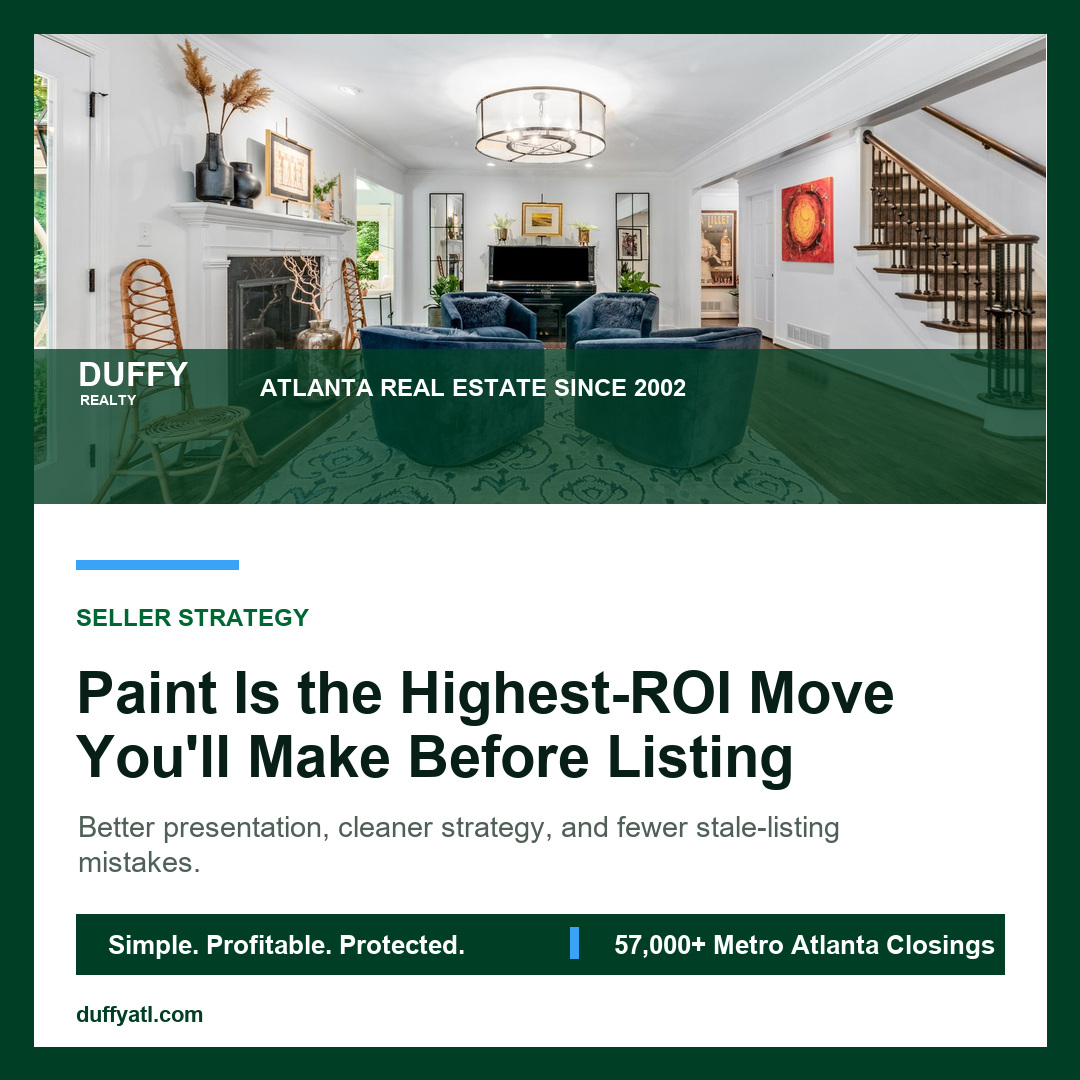
A gallon of paint costs $40. A dated room costs you $15,000 in perceived value. The math isn’t complicated — and neither is the color decision if you know what buyers actually respond to.

A gallon of paint costs $40. A dated room costs you $15,000 in perceived value. The math isn’t complicated — and neither is the color decision if you know what buyers actually respond to.
Of every dollar a seller can spend before listing, paint is the dollar that returns the most. It is not close. New flooring helps. Updated fixtures help. Fresh landscaping helps. None of them touch paint for raw return on investment.
And yet half the houses that come on the market in Atlanta still have an accent wall from 2014, a kid’s bedroom in lavender, or a primary bath in a green that was popular when Frasier was on the air. Each of those rooms is quietly subtracting value from the sale price. The owner doesn’t see it because they have lived with it. The buyer sees it the second they walk in.
Here is what the math actually looks like, what colors actually work, and what to skip.
The $40 Investment That Returns $15,000
The math behind paint ROI is simple. A gallon of quality interior paint runs $40 to $60. A typical room takes 1 to 2 gallons. A whole-house refresh — main living areas, hallways, primary bedroom, and the rooms most buyers see during a showing — runs maybe $400 to $800 in materials, plus labor if you hire it out. Call it $2,500 all-in for a professional job in a typical 2,500-square-foot home.
The return shows up in two places. First, in perceived condition: a freshly painted home reads as well-maintained, move-in ready, and cared for. Buyers don’t have to discount their offer to budget for paint, and they don’t have to mentally relocate furniture into a room they’re already imagining repainting. Second, in negotiation leverage: a home that shows clean and current resists low-ball offers far better than a home with visible cosmetic issues.
DUFFY makes this simpler.
If you are selling, this is where DUFFY gets useful: pricing, value details, syndication, negotiation, contract review, and a 1% listing fee.
The differential between a freshly painted home and an unpainted but otherwise identical home, in our experience across thousands of Atlanta sales, is consistently in the $10,000 to $20,000 range at the closing table. A $2,500 investment for a $15,000 return is not a hard call.
Colors That Sell in 2026 (and Why)
The current market favors warm neutrals over cool ones. The all-gray-everything era — 2015 through about 2022 — is fading. Buyers in 2026 respond better to soft whites with warm undertones, greiges (gray-beige hybrids), and creamy off-whites. The cold gray look now reads as dated.
Specific palettes that consistently perform in Atlanta listings include: Benjamin Moore Classic Gray (a soft warm neutral that works in nearly any light), Sherwin-Williams Accessible Beige (a versatile greige), Benjamin Moore White Dove (a soft warm white that handles north-facing rooms), and Sherwin-Williams Agreeable Gray (a true greige that has aged better than the cooler grays of the prior decade).
These are not exciting choices. They are not supposed to be. The goal of pre-listing paint is to make rooms feel light, clean, and ready for the buyer’s furniture — not to express the seller’s personality. Express your personality in the next house. Sell this one in colors that disappear.
Room-by-Room Recommendations
Different rooms benefit from different approaches:
Main living areas: warm neutral whites or light greiges. Avoid stark cool whites in north-facing rooms — they read blue and uninviting.
Kitchen: lighter than the living room if possible. Buyers associate light kitchens with cleanliness and space.
Primary bedroom: soft, warm, restful. Slight warmth (a creamy white or pale greige) outperforms bright white.
Bathrooms: clean white or pale neutral. Avoid statement colors here — buyers project their own taste onto bathrooms more than any other room.
Kids’ rooms: neutralize. Lavender, lime green, or themed murals all read as work-to-undo for the buyer. Repaint to a soft neutral before listing.
Trim and ceilings: bright clean white. Trim that has yellowed over time silently dates a whole room.
The Accent Wall Trap
The single most consistent mistake we see is the accent wall. Sellers love their accent walls. Buyers do not.
An accent wall — the navy blue dining room wall, the deep red feature behind the TV, the chalkboard wall in the kitchen — is a personal-taste statement. To a buyer, it is also a signal that the rest of the house may have similar personal-taste statements that aren’t to their taste either. The buyer’s brain starts cataloging future repaint costs.
Even tasteful accent walls tend to underperform. The buyer who likes navy blue will repaint anyway because they want their navy blue, not yours. The buyer who doesn’t like navy blue mentally subtracts the repaint cost from their offer. Either way, the wall is costing you something.
Repaint accent walls to the main wall color before listing. Universally. No exceptions. If the room genuinely needs visual interest, add it through art or a statement light fixture — both of which leave with you and don’t constrain the buyer’s imagination.
When NOT to Paint
Painting is high-ROI, but not infinite-ROI. There are situations where the math turns negative.
Don’t repaint walls that are already in a current, neutral color in good condition. Buyers can tell the difference between fresh paint and recently fresh paint, and the marginal benefit of repainting an already-acceptable color is minimal. Spend the money where it matters.
Don’t undertake exterior repaints in the 30 days before listing. Exterior paint takes time to weather and look settled. A house painted three weeks before listing photos can read as a flip — and triggers buyer suspicion about what else has been hastily covered up.
Don’t paint over real problems. If a wall has water staining, the buyer’s inspector will find the underlying issue and the fresh paint will read as a cover-up — which is worse than the original stain would have been. Fix the underlying problem first, then paint.
And don’t get ambitious with the colors. Unusual choices — even tasteful ones — narrow your buyer pool. The job of pre-listing paint is to widen the pool, not narrow it.
If you want the broader playbook on pre-listing prep, our guides on how to make the most money selling your home and DUFFY’s seller and buyer tips for success and profit cover the full sequence. Paint is the place to start. It is the cheapest dollar you will spend on this sale, and the most reliably profitable.
Quick Answers
What’s the best color to paint a house before selling?
Warm neutrals consistently perform best in 2026 — soft whites, greiges (gray-beige blends), and creamy off-whites. Specific palettes like Benjamin Moore Classic Gray, Sherwin-Williams Accessible Beige, Benjamin Moore White Dove, and Sherwin-Williams Agreeable Gray work across most lighting conditions and broaden buyer appeal. The goal is to make rooms feel light, clean, and ready for the buyer’s furniture — not to express personal style.
Do I need to paint before listing?
If your existing paint is dated, has accent walls, shows wear or marks, or is a strong color, yes — paint is the highest-ROI pre-listing investment available. If your walls are already in a current neutral and in good condition, repainting may not be necessary. The decision is room-by-room, and an experienced agent can walk through and identify which rooms actually benefit.
Is it worth repainting cabinets?
Sometimes. Repainting dated kitchen cabinets — particularly oak cabinets from the 1990s — can deliver strong returns when done well. Poorly done cabinet painting, however, looks worse than the original and can hurt the sale. If you’re not hiring a professional with cabinet-specific experience, it is often better to leave them and price accordingly. Bath cabinets are a smaller risk and often worth a refresh.
Keep inspecting the DUFFY standard.
Before you pay more, inspect what DUFFY actually built: protection, proof, strategy, and a simpler path from first question to closing.
Quick Answers
What’s the best color to paint a house before selling?
Warm neutrals, soft whites, creamy off-whites, and balanced greiges usually photograph and show better than loud, cold, or dated colors.
Do I need to paint before listing?
If paint makes the home feel cleaner, fresher, and better maintained, it can be one of the highest-return pre-listing moves. Not every room needs it, but obvious dated colors hurt.
Is it worth repainting cabinets?
Sometimes. Repainting cabinets can help when the finish is dated but the cabinet structure is good. It should be evaluated against cost, buyer expectations, and the home’s price point.
Next week: keep going.
DUFFY’s blog path is built to make sellers and buyers sharper each week. Simple, easy, protected.