Sellers / Marketing / DUFFY Take
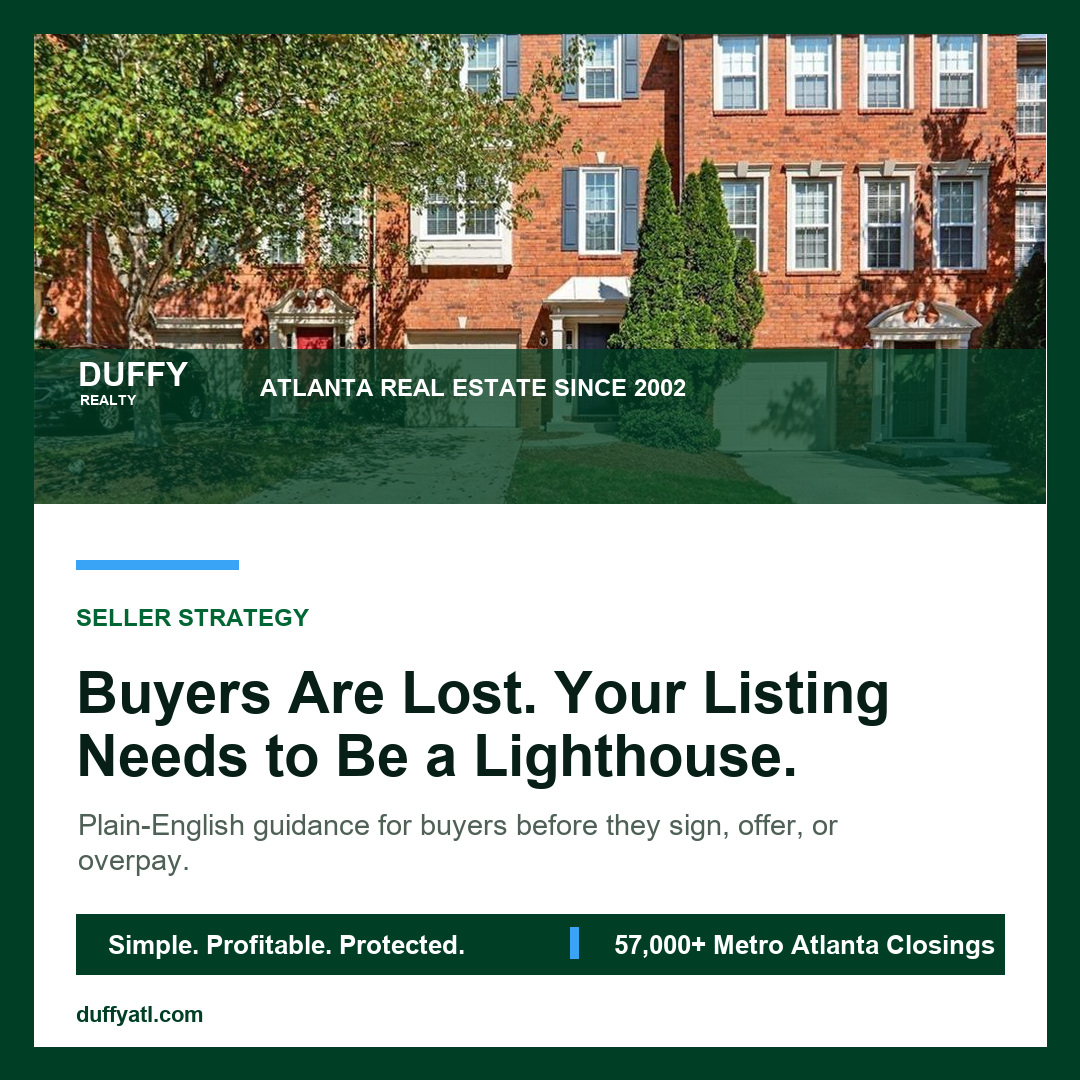
The average buyer looks at 300+ listings online before touring 10. Your job isn’t to be one of the 300 — it’s to be one of the 10.

The average buyer looks at 300+ listings online before touring 10. Your job isn’t to be one of the 300 — it’s to be one of the 10.
Imagine you are a buyer in Atlanta right now. You have a budget. You have a target neighborhood. You have a vague list of must-haves. You open Zillow on your phone before bed and start scrolling.
Within ten minutes, you have looked at 40 listings. Within a week, 200. By the time you are ready to actually request a showing, you have casually evaluated somewhere north of 300 homes — and the vast majority of them have already blurred together in your memory. You couldn’t tell a stranger which one had the renovated kitchen and which one had the dated bath. They merge into a fog.
This is the modern buyer’s reality. They are drowning in inventory. And the seller’s job — your job — is not to be merely listed. It is to be the listing the buyer remembers.
The Modern Buyer’s Search Journey
Real-estate search behavior in 2026 looks almost nothing like it did even five years ago. The funnel has gotten longer at the top, more compressed at the bottom, and ruthlessly visual all the way through.
DUFFY makes this simpler.
If you are selling, this is where DUFFY gets useful: pricing, value details, syndication, negotiation, contract review, and a 1% listing fee.
A typical Atlanta buyer now spends weeks or months in the casual-browse phase before they ever engage with an agent. They use Zillow most often, with Realtor.com and Redfin in supporting roles, and they increasingly cross-reference listings on TikTok and Instagram for neighborhood context. They save listings to private folders. They send screenshots to spouses, partners, and friends. They build internal narratives about each home before ever seeing it.
By the time they actually schedule showings, they have narrowed the field from hundreds of casual views to roughly a dozen serious considerations. Of those dozen, they tour 8 to 10 in person. Of those 8 to 10, they make offers on 1 or 2.
The math is brutal for sellers. Your listing has to survive multiple rounds of cuts to get to the offer stage. Most listings die in the first round — the casual-scroll round — without the seller ever knowing.
Decision Fatigue Is Real
Buyers don’t experience their search as an analytic process. They experience it as cognitive overload. By the 80th listing in a session, decision fatigue has set in. The brain stops carefully evaluating each home and starts making fast, pattern-based judgments to conserve energy.
This is why generic listings vanish. The fatigued brain has already seen 50 beige exteriors, 50 white kitchens, and 50 walk-in-closet shots. It is not going to deeply evaluate the 51st version. It will scroll past, save the ones that broke the pattern, and move on.
The implication for your listing: the more your home blends into the average, the more invisible it becomes — even if it is a perfectly good home. Standing out is not vanity. It is survival.
The Lighthouse Listing Framework
A lighthouse listing has five characteristics. Each one independently increases your visibility; together they compound.
A hero photo that stops thumbs. Not the front of the house. The strongest interior shot — depth, light, focal point — that breaks the pattern of the search results.
A description that opens with a specific, vivid, surprising detail. Not "welcome to this beautiful home." Something a buyer can picture in 5 seconds. The renovated kitchen with the original 1928 stained-glass transom. The screened porch that looks into the trees. Specificity beats superlatives every time.
Photo sequencing that tells a story. The hero, then the reveal, then the expansion. Not a checklist march through every room.
A pricing strategy that maximizes search-bracket visibility. (Round numbers, as we covered in week 3, are doing real work here.)
A clear point of differentiation. What makes this house different from the next five comparable listings? If you can’t articulate it in one sentence, the buyer won’t either.
A listing that hits all five gets meaningfully more saves, more shares, more requests for tours, and ultimately more offers — frequently at higher prices — than an otherwise comparable listing that hits two or three.
Where Most Listings Fail
We see the same failure points repeatedly across Atlanta listings. The hero photo is the front of the house, taken at noon, with no shadows and no drama. The description opens with a generic phrase that could be cut and pasted to any of the 200 listings the buyer has already scrolled past. The photo sequence marches through every room as if completing a checklist. The price is set at $499,900 because someone read about psychological pricing in 2003. The differentiator — the actual reason this house is interesting — is buried in the third paragraph of the description, where nobody will ever read it.
Each of those failures is independently fixable. None of them require a more expensive home. None of them require a renovation. They require intent — and a listing process that treats marketing as the work, not as the afterthought.
The brutal truth is that two identical homes, listed with different marketing approaches, can produce dramatically different outcomes. Same square footage. Same bedrooms. Same finishes. One generates 30 saves and 8 showings the first weekend. The other generates 4 saves and a single tepid showing. The houses are the same. The lighthouse signal isn’t.
DUFFY’s Visibility System
We treat marketing as the listing’s primary job. Every DUFFY listing goes through the same visibility framework — strategic photography, intentional photo ordering, descriptions written for the modern scroll, pricing built around buyer search behavior, and a clear articulation of what makes the home different from its competitors.
We also list in two MLS systems instead of one, ensuring our listings reach the full set of agents and buyer search platforms in Atlanta. (We will go deeper on the dual-MLS strategy in week 36.) We syndicate to the major portals where modern buyers actually search. We coordinate the photo timing, the listing launch timing, and the social distribution to give the listing the best possible first 72 hours — which research consistently shows are the most decisive window for any new listing’s performance.
If you want to see how this fits into the broader process, our overview of how your sale is managed at DUFFY and our DUFFY listing photography experience walk through the operational pieces.
Buyers in 2026 are not lazy. They are overwhelmed. Your job as a seller is not to compete on volume of inventory — there is too much of that already. Your job is to be the listing that pierces the fog. The lighthouse. The one they save, send to their partner, and remember three days later when they’re narrowing down their tour list.
Be the listing they remember. Everything follows from that.
Quick Answers
How do I make my home listing stand out?
Five elements consistently differentiate listings: a hero photo with depth, light, and a focal point (not a generic exterior); a description that opens with a specific vivid detail rather than generic praise; thoughtful photo sequencing that tells a narrative; pricing strategy that maximizes visibility in buyer search brackets; and a clear point of differentiation that the listing communicates immediately. Each works independently — together, they compound.
What gets buyers to schedule a showing?
Buyers schedule showings for listings they remember after scrolling. Memorability comes primarily from a strong hero photo and a specific, vivid description hook. Listings that get saved to private folders, shared with partners, or revisited multiple times convert to showings at significantly higher rates. The first 72 hours of a listing are particularly decisive — listings that perform well in their initial visibility window almost always go on to perform well overall.
Does social media marketing for real estate work?
Yes, particularly when it amplifies an already-strong listing rather than substituting for one. Social posts on Instagram and TikTok drive supplemental visibility and reach buyers earlier in their journey, before they’ve engaged with an agent. However, social marketing on a weak listing — poor photos, generic description, undifferentiated positioning — does not rescue the listing. The fundamentals come first.
Keep inspecting the DUFFY standard.
Before you pay more, inspect what DUFFY actually built: protection, proof, strategy, and a simpler path from first question to closing.
Quick Answers
How do I make my home listing stand out?
A listing stands out when it is clear, emotionally memorable, easy to understand, and supported by strong photos, value details, accurate syndication, and a pricing strategy.
What gets buyers to schedule a showing?
Buyers schedule showings when the listing answers their practical questions and gives them an emotional reason to inspect the home in person.
Does social media marketing for real estate work?
Social media can help, but it is not a substitute for MLS syndication, strong listing photos, pricing strategy, and buyer-facing value details.
Ready to move from reading to strategy?
Call us, talk it out, or start the form. We built this for people who value money, sanity, and time.