Sellers / Pricing Strategy / DUFFY Take
$485,900 is a price picked by a committee. $500,000 is a price picked by a strategist. Here’s why clean round numbers outperform "calculated" ranges — and what the MLS search bar has to do with it.
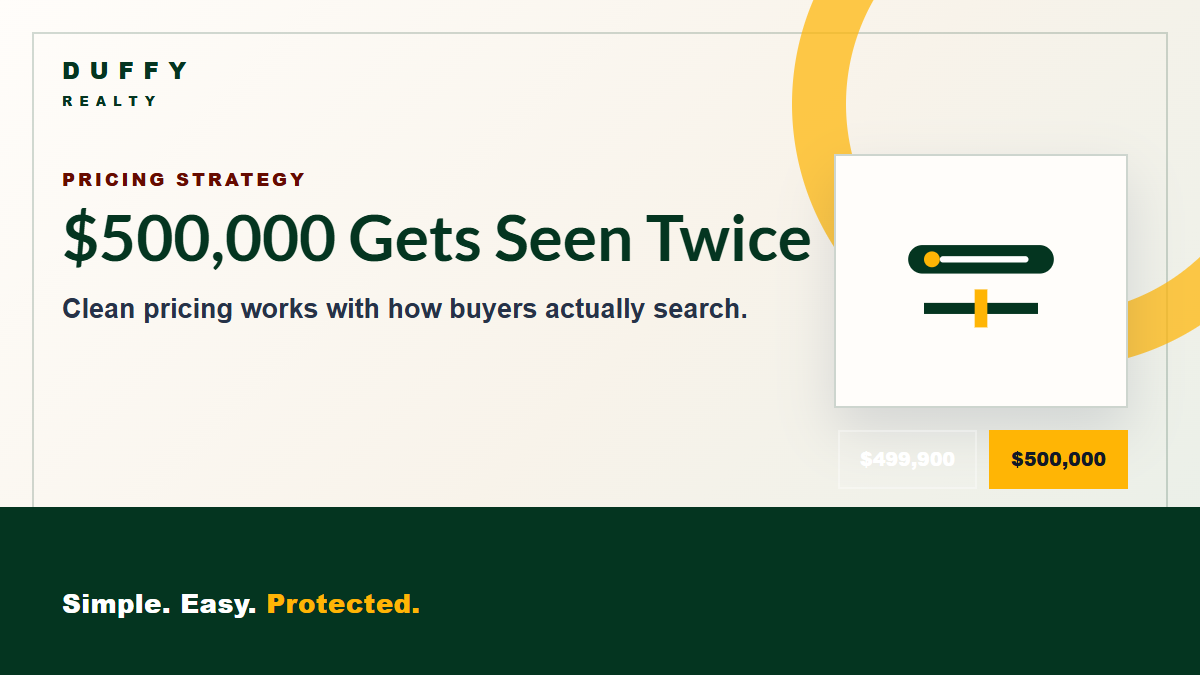
$485,900 is a price picked by a committee. $500,000 is a price picked by a strategist. Here’s why listing at clean, round numbers outperforms ‘calculated’ ranges — and what the MLS search bar has to do with it.
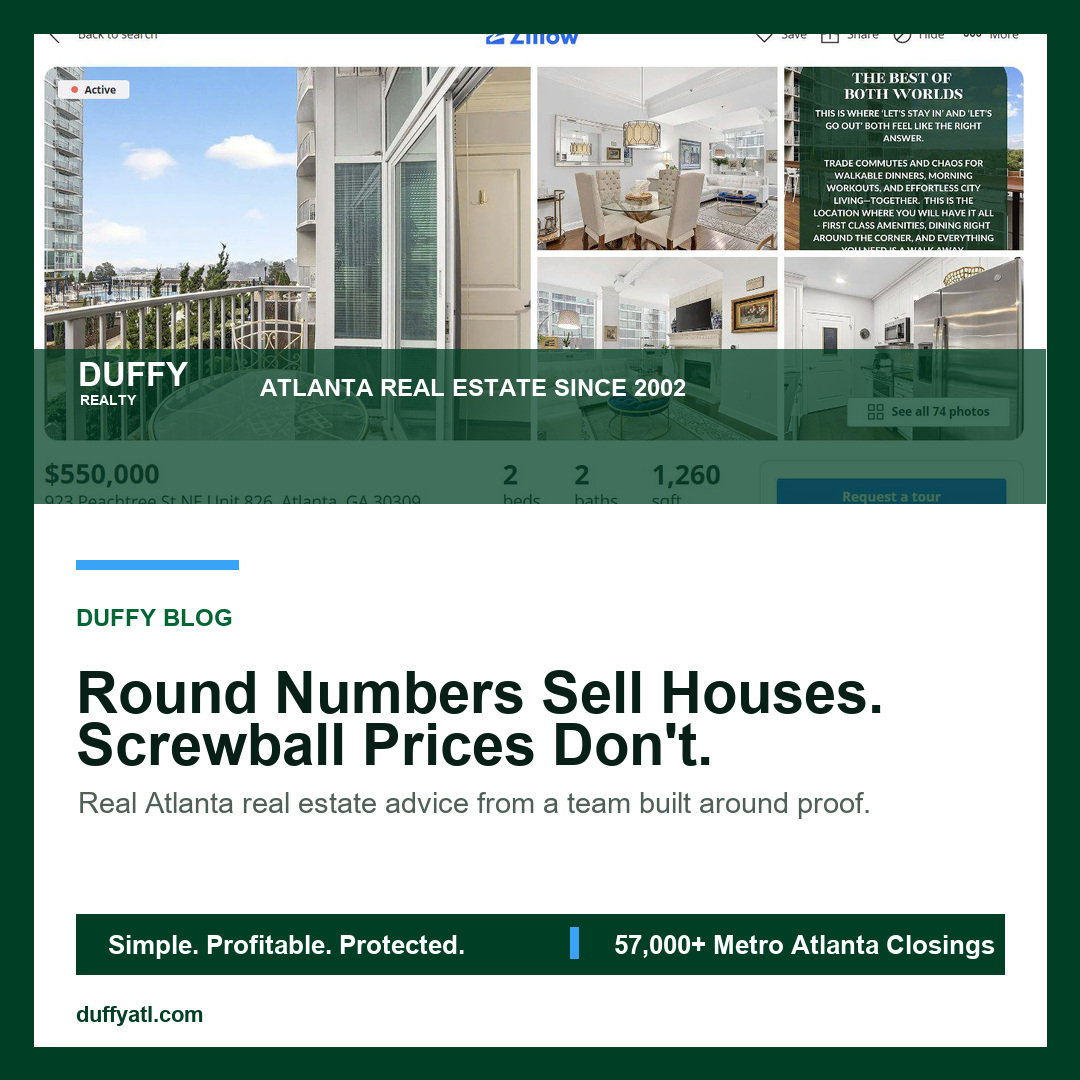
Walk through any neighborhood in Metro Atlanta and pull up the active listings. You will see prices like $487,750, $619,900, and $549,500. Those numbers feel deliberate. They feel like someone did math. They look like the listing agent priced for precision.
They didn’t. They priced for the appearance of precision — which is a different thing entirely. And in most cases, those screwball numbers are quietly costing the seller showings, money, or both.
Round numbers — $500,000, $600,000, $750,000 — outperform odd-priced listings for one specific reason that has nothing to do with psychology or charm pricing. It has to do with how buyers actually find homes online.
How Buyers Actually Search the MLS (Price Filter Math)
Buyers don’t browse listings the way they did in 1998. They use price filters. On Zillow, Realtor.com, the MLS, and every major search portal, the buyer drags a slider or types a number — and the most common numbers they type are round.
$400,000 to $500,000. $500,000 to $600,000. $600,000 to $750,000. These are the brackets buyers actually use. Almost nobody types $487,000 to $543,000. Nobody.
DUFFY makes this simpler.
If you are selling, this is where DUFFY gets useful: pricing, value details, syndication, negotiation, contract review, and a 1% listing fee.
Now apply that to your house. If you list at $487,750, you appear in searches set from $450,000 to $500,000 — and you are at the top of that bracket. The buyer searching that range is looking at houses 8% cheaper than yours and wondering why yours is the most expensive option in their list. You look like the splurge.
If you list at $499,900, you are still in the $450K–$500K bracket — barely — and you have effectively eliminated yourself from every buyer searching $500K and up. You vanish from the searches of people who can actually afford and want to spend half a million dollars.
If you list at $500,000, you appear in both brackets. You are at the top of the $450K–$500K search and at the bottom of the $500K–$600K search. You just doubled your visible audience.
The $499,999 Trap
The classic discount-store pricing trick — $499,999 instead of $500,000 — was invented for retail, where shoppers see one price at a time on a shelf. It does not survive the migration to a real estate search portal.
On a search portal, your price is being compared in a list. The buyer sees $499,900 next to $499,000, $497,500, $495,000, and $489,900. The dollar you saved by listing at $499,999 instead of $500,000 didn’t make your house feel cheaper — it just dropped you out of the next price tier of buyers entirely.
Worse, $499,999 telegraphs something to experienced buyers and agents: you are pricing to a psychological trick because you couldn’t justify $500,000. That’s not the signal a confident seller wants to send.
Why Round Numbers Signal Confidence
There is a secondary effect, and it’s worth naming. When you list at $500,000 instead of $499,900, you are telling buyers that this is what the home is worth. Not $500K minus a hundred bucks of marketing theater. Five hundred thousand dollars. Period.
Buyers — especially the most qualified ones — read confidence in pricing. They are also reading uncertainty when they see it. A price like $483,750 looks like the seller and the agent argued and met in the middle. A price like $485,000 looks like a compromise. A price like $500,000 looks like a decision.
Confidence does not mean rigidity. Round-number sellers still negotiate. They just negotiate from a clearer starting position — and frequently end up closer to their ask than the seller who anchored at an apologetic $483,750.
The Psychology of Pricing Decisions
Where do screwball prices actually come from? They come from one of three places, and none of them are strategic.
An automated algorithm. AVMs and home value calculators spit out numbers like $487,432 because that’s what the regression equation produced. Sellers and inexperienced agents copy the number into the listing without rounding.
A negotiated compromise. The seller wanted $510,000 and the agent recommended $475,000. They split the difference at $492,500. The number reflects the argument, not the market.
An attempt to feel scientific. Some sellers think a precise number signals research. It usually signals the opposite — a confident, well-supported price doesn’t need three significant digits to back it up.
If your listing price ends in anything other than zeros, ask the question: where did this number actually come from? If the answer isn’t "strategy," it’s costing you something.
Round Numbers and the Negotiation Effect
There is a second, less-discussed reason round numbers outperform. It’s how they shape the negotiation that follows.
When a buyer offers on a house listed at $499,900, what does a typical counter look like? $497,500. $495,000. The negotiation moves in awkward, granular increments because the asking price was already granular. Both parties end up haggling over $2,500 chunks that feel like rounding errors.
When a buyer offers on a house listed at $500,000 and comes in at $485,000, the natural counter is $495,000 or $500,000 firm. The negotiation has clean reference points. The seller’s counters land at psychologically meaningful numbers. And critically, the gap between offer and ask feels conceptually smaller to the buyer when the asking number is round, because the buyer has been mentally anchoring to "five hundred" — not to "four-ninety-nine-nine."
Round-number sellers consistently close at a higher percentage of list price than odd-priced sellers in the same market. Some of that is the visibility effect from the search bar. Some of it is the confidence signal. And some of it is simply that round-number negotiations don’t degrade into penny-counting the way odd-priced ones do.
How DUFFY Prices Listings
We anchor every listing to the MLS search brackets your buyers are actually using. We pull the comparables, identify the relevant price tiers in your submarket, and price you at the round number that gives you maximum visibility on both sides of a bracket whenever possible.
Sometimes that means listing slightly higher than a strict comparables analysis suggests, because the next round number above gives you a stronger negotiating position and a wider buyer pool. Sometimes it means listing at the round number below, because the bracket above is saturated with stale inventory and you’ll be the freshest option in a hungrier search.
This is the kind of nuanced pricing decision that most listing presentations skip — because it’s harder to explain in a 30-minute pitch than "let’s list at $499,900 and see what happens." If you want to dig deeper, our guides on how to make the most money selling your home and the DUFFY 1% listing commission walk through the full pricing approach.
Round numbers aren’t a gimmick. They are how the MLS works in 2026. Price your house like the search bar is real — because it is.
Quick Answers
Should I list at $499,900 or $500,000?
$500,000. Listing at $499,900 keeps you at the top of the $450K–$500K search bracket but eliminates you from every buyer searching $500K and up. Listing at $500,000 places you in both brackets simultaneously, doubling your visible audience. The dollar you save with the $499,900 trick costs you a much larger pool of qualified buyers.
Do buyers search in price ranges?
Yes — almost universally. Modern buyers use price filters on Zillow, Realtor.com, and the MLS, and they overwhelmingly use round-number brackets like $400K–$500K or $500K–$600K. Pricing your home at a round number positions it at the boundary of two brackets, maximizing the searches it appears in.
Does pricing strategy really matter?
Significantly. Pricing strategy controls which buyers see your home, how it compares against active listings in their search results, and what signal your price sends about your confidence and flexibility. Two homes with identical features can perform very differently based on pricing strategy alone, often resulting in tens of thousands of dollars in difference at closing.
Keep inspecting the DUFFY standard.
Before you pay more, inspect what DUFFY actually built: protection, proof, strategy, and a simpler path from first question to closing.
Quick Answers
Should I list at $499,900 or $500,000?
Usually, clean round numbers are stronger because buyers search in round-number price bands. Pricing just under a threshold can hide your home from buyers searching above that threshold.
Do buyers search in price ranges?
Yes. Buyers use price filters on the MLS, Zillow, Realtor.com, and other sites. Those filters usually follow clean price brackets, which is why pricing strategy matters.
Does pricing strategy really matter?
Yes. Pricing affects search visibility, buyer psychology, negotiation leverage, and whether the market understands your value quickly.
Next week: keep going.
DUFFY’s blog path is built to make sellers and buyers sharper each week. Simple, easy, protected.