Sellers / Contract Protection / DUFFY Take
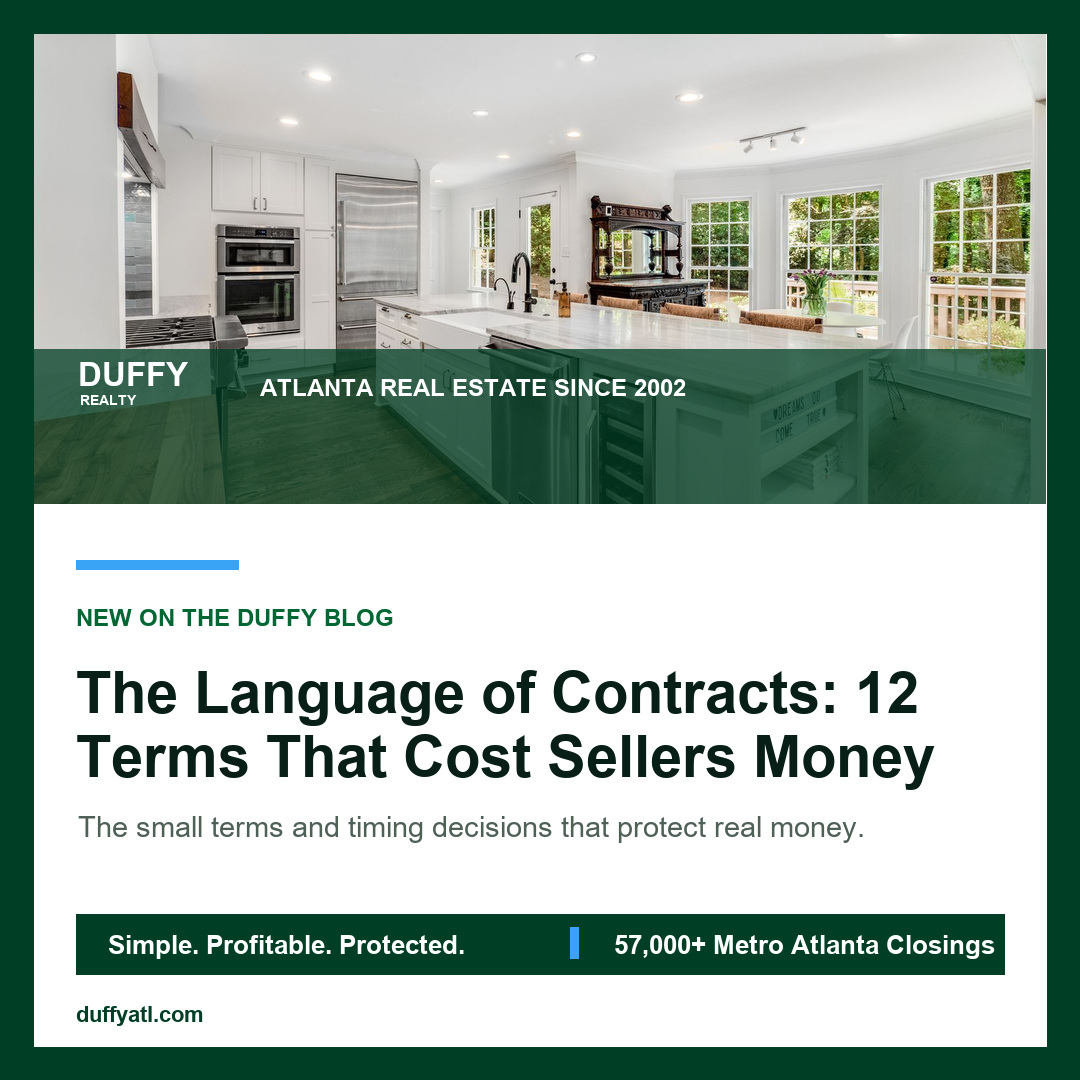
The Language of Contracts: 12 Terms That Cost Sellers Money
A real estate contract in Georgia is roughly 14 pages of dense, single-spaced legal language. Most sellers sign it without reading it. Most listing agents skim it. Most buyers’ agents have only memorized the parts that benefit their side.

‘Customary’ doesn’t mean ‘required.’ ‘As-is’ doesn’t mean ‘no inspection.’ Here are the 12 contract terms that lose sellers thousands when misunderstood.
Inside those 14 pages are roughly 200 distinct terms and phrases. Most of them are routine. About a dozen of them — the ones below — quietly cost sellers thousands of dollars when misunderstood. Sometimes tens of thousands.
Here are the twelve terms every Georgia seller should know cold before they sign anything. Each one has a precise legal meaning, a common misunderstanding, and a strategic implication.
Terms 1–3: The Inspection Language
1. ‘As-is’
What sellers think it means: “The buyer agrees not to inspect.”
DUFFY makes the decision sharper.
Selling gets expensive when strategy is weak. DUFFY helps protect price, timing, contracts, and leverage before the market starts talking back.
What it actually means: “The seller is not making warranties about the condition of the property.” The buyer can still inspect, can still negotiate based on inspection findings, and can still terminate during due diligence. As-is shifts the risk of latent defects, but it does not eliminate the inspection process or the buyer’s negotiating leverage.
Strategic implication: An as-is listing is often more about psychology than law. It signals “don’t ask me to fix things.” It does not guarantee that the buyer won’t ask. Sellers who list as-is should still expect repair requests during due diligence — and should price accordingly.
2. ‘As inspected’
What sellers think it means: Same as as-is.
What it actually means: “The buyer accepts the property in the condition documented by the inspection.” This is a stronger seller protection than as-is because it ties acceptance to a specific document. Once the inspection is complete and the buyer waives objections, the buyer cannot return after closing claiming undisclosed issues.
Strategic implication: As-inspected language is stronger than as-is for sellers. Use it if the buyer is willing to accept it. Most won’t, but it’s worth the ask.
3. ‘Cure period’
What sellers think it means: A vague window for fixing things.
What it actually means: A specific, contractually-defined time during which a defaulting party can fix the default before the other party can terminate. In Georgia GAR contracts, the cure period for closing-day defaults is typically 7 days.
Strategic implication: If the buyer’s loan is delayed and they technically default at closing, the seller cannot immediately terminate. The cure period gives the buyer 7 days to fix the issue. Sellers who don’t know about the cure period sometimes panic-list the property again, only to find the original deal isn’t actually dead.
Terms 4–6: The Financing Language
4. ‘Contingent on financing’
What sellers think it means: “The buyer probably has financing.”
What it actually means: “If the buyer cannot obtain financing on the terms specified in the contract, they can terminate and recover earnest money.” The financing contingency is the buyer’s safety net — and one of the most common reasons deals fall apart.
Strategic implication: A financing contingency is not the same as a pre-approval. Pre-approval means the lender has reviewed the buyer’s basic information. The actual loan approval comes after underwriting, often 30+ days into the contract. Sellers should ask about the buyer’s pre-underwriting status — it’s a stronger signal than basic pre-approval.
5. ‘Subject to appraisal’
What sellers think it means: A normal lender-required step.
What it actually means: If the appraisal comes in below contract price, the buyer can terminate, renegotiate, or bring cash to bridge the gap. Without a separate appraisal contingency or appraisal gap coverage, a low appraisal almost always renegotiates the price downward — or kills the deal.
Strategic implication: In competitive markets, sellers can ask buyers to waive the appraisal contingency, cap their appraisal gap (e.g., “buyer will bring up to $15,000 if appraisal comes low”), or guarantee no renegotiation. Strong buyers can do these things. Weak buyers can’t.
6. ‘Lender-required repairs’
What sellers think it means: A formality if anything.
What it actually means: Specific repairs the lender requires before they will fund the loan, typically tied to FHA, VA, or USDA loan programs. Most common: peeling paint on pre-1978 homes (lead concern), missing handrails, broken windows, exposed electrical, plumbing leaks.
Strategic implication: If your buyer is using FHA or VA financing and your house has issues that would trigger lender-required repairs, you’ll be making repairs you didn’t expect to make. Sellers can request that the buyer pay for these repairs (sometimes successful, often not) or proactively address them before the appraisal.
Terms 7–9: The Contingency Language
7. ‘Time is of the essence’
What sellers think it means: “We should move quickly.”
What it actually means: All deadlines in the contract are strict. Missing a deadline by one day is a contract breach. There is no implied grace period.
Strategic implication: When a contract states “time is of the essence,” calendar discipline becomes critical. The buyer’s due diligence deadline at midnight on day 10 is exactly midnight, not the next business day. Most Georgia GAR contracts include this language. Treat every deadline as inviolable.
8. ‘Binding agreement date’
What sellers think it means: The day the contract was negotiated.
What it actually means: The date the last party signed the contract and that signature was communicated to the other party. This is the date that starts the clock on every other deadline — due diligence, financing, closing date.
Strategic implication: The binding agreement date can be hours or even days different from when the seller thinks the contract was finalized. Confirm the BAD with the closing attorney before relying on any other deadline. We’ve seen buyers miss due diligence by 18 hours because they thought the clock started a day earlier than it did.
9. ‘Right of first refusal’ and ‘right to cure’
What sellers think it means: Generic legal padding.
What it actually means: Specific contractual rights that can resurrect deals sellers think are dead — or kill deals sellers think are alive. A right to cure (mentioned above as cure period) gives the defaulting party a chance to fix the default. A right of first refusal (in the rare cases it appears) gives a third party — usually a current tenant or HOA — the right to match any offer.
Strategic implication: Read these provisions carefully. They sometimes appear in contracts involving rental properties, family transfers, or HOA-controlled communities. Missing them creates legal exposure post-closing.
Terms 10–12: The Closing Language
10. ‘Customary’
What sellers think it means: “Required.”
What it actually means: “Common practice in this market.” Customary is not legal. It is not required. Every “customary” charge — closing attorney choice, title insurance party, transfer tax allocation, survey responsibility — is negotiable.
Strategic implication: This is the single most expensive misunderstanding in Georgia real estate. “Customary” charges allocated to the seller in the GAR contract default forms can total $4,000–$12,000 per transaction. Every one of them is on the table. Every one of them can be reallocated, reduced, or eliminated through negotiation. Sellers who treat customary as required are leaving money on the table by default.
11. ‘Liquidated damages’
What sellers think it means: A penalty for the buyer if they walk.
What it actually means: A pre-agreed amount (typically the earnest money) that the seller can keep if the buyer defaults — and it caps the seller’s remedy. The seller cannot sue for additional damages beyond the liquidated amount.
Strategic implication: If a buyer defaults and the seller wants to keep the earnest money plus pursue actual damages (lost time, carrying costs, second listing expense), the liquidated damages clause prevents that. In some situations sellers should negotiate for “specific performance” instead — see term 12.
12. ‘Specific performance’
What sellers think it means: Dense legal jargon.
What it actually means: A legal remedy where the court orders the breaching party to perform their contractual obligation rather than just paying damages. In real estate, specific performance can force a defaulting buyer to actually close on the purchase.
Strategic implication: Specific performance is the seller’s strongest legal tool when a buyer defaults. It is rarely invoked because it requires litigation, but its presence in the contract is a deterrent. Sellers who negotiate for specific performance rights get more compliant buyers throughout the transaction. The threat itself has value.
How DUFFY Reviews Every Term
Every contract that comes through a DUFFY listing gets reviewed line by line — not skimmed, not assumed, not signed because “that’s how it always reads.” The review covers all twelve terms above, plus another 50 or so that matter less but still matter.
We negotiate the terms that have economic impact: customary cost allocations, financing language, contingency timelines, inspection terminology, default remedies. We push back on language that disadvantages the seller. We accept language that’s actually required by law (a much smaller list than most agents pretend).
The seller’s listing agent is supposed to be the one reading the contract carefully. Most aren’t. Most are eager to get the contract signed and move on. The result, repeated across thousands of transactions, is sellers signing language they don’t understand and paying for it months later — at closing, in disputes, in unexpected credits, in lost net proceeds.
Don’t sign a contract you haven’t read. If your agent can’t explain every term in plain English in under a minute, get a different agent or a lawyer. The 14 pages of a Georgia real estate contract are the second-most-important document in your sale. The first is the deed at closing. They both deserve careful reading.
Quick Answers
(These are formatted as FAQPage schema in JSON-LD on the live page.)
What does ‘as-is’ mean in real estate?
‘As-is’ means the seller is not making warranties about the property’s condition and is not agreeing in advance to make repairs. It does not mean the buyer cannot inspect — buyers retain full inspection rights and can terminate during due diligence. As-is shifts the risk of latent defects to the buyer at closing, but it does not eliminate the buyer’s negotiating leverage during the inspection process. Sellers should still expect repair requests on as-is listings and should price accordingly.
What is a financing contingency?
A financing contingency is a clause in a real estate contract that allows the buyer to terminate the agreement and recover their earnest money if they cannot obtain financing on the terms specified in the contract. It is the buyer’s primary safety net against being forced to close without a loan. Pre-approval letters are not the same as fully underwritten loan approval — financing contingencies remain active well into the contract period (often 21-30 days) and are one of the most common reasons real estate transactions fall through.
What does ‘time is of the essence’ mean in a contract?
‘Time is of the essence’ means all deadlines in the contract are strict and enforced. Missing a deadline by even one day is considered a contract breach, and there is no implied grace period. In Georgia GAR contracts, this language typically appears in the standard form. It applies to due diligence deadlines, financing deadlines, closing dates, and any other contractually-specified date. Sellers and buyers must treat every contract date as inviolable, with deadlines counted as calendar days (not business days) unless specifically stated otherwise.
PRODUCTION NOTES
Image concept: Illustration: magnifying glass over a contract, with 12 flagged phrases highlighted in red
Internal links to insert: /how-your-sale-is-managed-at-duffy/ | /contract-to-closing-assistance/
Schema to deploy: FAQPage • DefinedTerm (each contract term) • Article • LegalService • RealEstateAgent
Keep inspecting the DUFFY standard.
Before you pay more, inspect what DUFFY built: protection, proof, strategy, and a simpler path from first question to closing.
Quick Answers
What does ‘as-is’ mean in real estate?
As-is does not mean the buyer cannot inspect. It usually means the seller is signaling they do not plan to make repairs, but contract language and due diligence still matter.
What is a financing contingency?
A financing contingency gives the buyer protection tied to loan approval. Sellers need to understand the deadline, the buyer’s lender strength, and how that language can affect certainty.
What does ‘time is of the essence’ mean in a contract?
Time is of the essence means deadlines matter. Missing a date can change rights, leverage, and sometimes the entire deal.
Ready to move from reading to strategy?
Call us, talk it out, or start the form. We built this for people who value money, sanity, and time.