Both / Contract Details / DUFFY Take
The Home Warranty Debate: Should Sellers Include One?
Closing day. Everyone signs. Everyone hugs. The buyers move in over the weekend. Three weeks later, the HVAC compressor dies. The buyers’ agent calls your agent. The buyers’ agent says the buyers are “upset” and “considering options.” Your agent calls you. You’re now negotiating a credit on a house you no longer own.
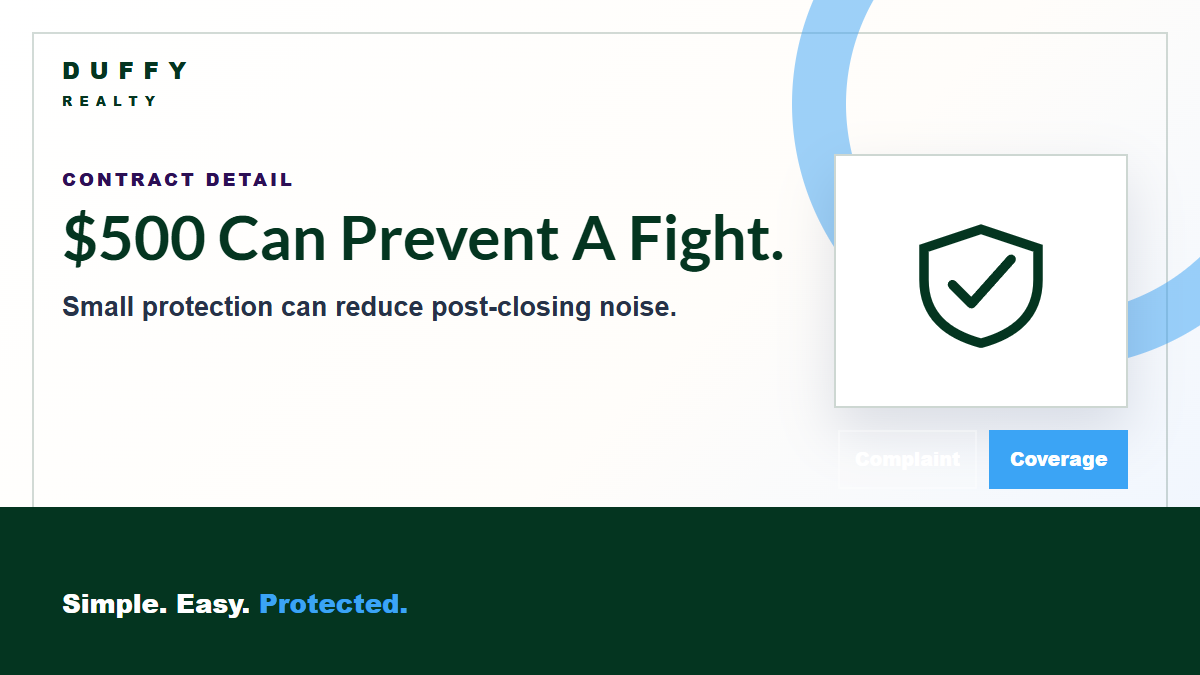
$500 home warranty. Covers 80% of post-closing complaints. Yet most agents treat it as optional. Here’s the case for including one every single time.
This conversation happens dozens of times a month in metro Atlanta. The HVAC, the water heater, the dishwasher, the garbage disposal, the refrigerator. Something fails in the first 90 days of buyer ownership and the buyer wants the seller to pay for it. Sometimes there’s a contract basis for the request. Sometimes there isn’t. Either way, it’s now a problem.
A seller-paid home warranty — costing about $500 — eliminates roughly 80% of these conversations. It’s the cheapest, most overlooked piece of transaction protection in residential real estate. Here’s what it actually does, what it doesn’t, and why we recommend it on most listings.
What a Home Warranty Actually Covers
A home warranty is a one-year service contract that covers repair or replacement of major home systems and appliances when they fail due to normal wear and tear. It is not insurance (which covers sudden, unexpected damage from external events). It is not a builder’s warranty (which covers construction defects). It is a service plan that takes calls from buyers when something breaks and dispatches repair contractors.
Standard coverage in metro Atlanta typically includes:
HVAC system (heating and cooling)
DUFFY makes the decision sharper.
Whether you are selling, buying, or comparing models, the point is the same: inspect the money, timing, contract, and strategy before pressure starts making decisions for you.
Water heater
Plumbing (interior pipes, toilets, faucets)
Electrical (interior wiring, switches, outlets, breakers)
Major kitchen appliances (refrigerator, dishwasher, range, microwave, garbage disposal)
Washer and dryer (if included)
Ductwork
Some optional add-ons: pool/spa equipment, well pump, septic system, roof leaks
What’s typically excluded: cosmetic issues, pre-existing conditions the buyer should have caught during inspection, systems with improper installation, structural problems, exterior issues (siding, decks, fences), and anything covered by manufacturer warranty or homeowners insurance.
The buyer activates the warranty after closing, calls the warranty company when something fails, pays a service fee (typically $75-$125 per call), and the warranty company dispatches a contractor or arranges replacement. The seller’s involvement ends at closing — that’s the entire point.
The Post-Closing Complaint Stat
Across thousands of DUFFY closings, we’ve watched the post-closing complaint pattern repeat itself with predictable frequency. Roughly 15-20% of closings produce some form of buyer complaint within the first 90 days. Most aren’t legitimate — the buyer found something they didn’t catch during due diligence and is hoping the seller will absorb the cost. Some are legitimate — a system that was working at closing failed shortly afterward.
Either way, the conversation is the same: the buyer wants the seller to pay. The seller resents being asked. The agents end up mediating. Most disputes resolve at the seller giving up some money, not because they had to legally, but because the alternative was potential litigation, ongoing dispute, or referral damage.
A home warranty pre-empts roughly 70-80% of these conversations. The buyer’s first reflex when something breaks isn’t to call the seller — it’s to call the warranty company. The contractor shows up. The repair happens. The seller never knows there was a problem. The math is brutal: $500 to prevent thousands of dollars of post-closing friction.
Why $500 Prevents $15,000 Problems
Major home system failures aren’t cheap. Replacement costs in metro Atlanta:
HVAC compressor failure: $2,500-$5,000
Full HVAC system replacement: $7,000-$15,000
Water heater replacement: $1,200-$3,500
Major plumbing repair (slab leak, sewer line): $3,000-$10,000+
Electrical panel replacement: $2,000-$4,000
Refrigerator replacement: $1,500-$3,000
When one of these fails three weeks after closing, the buyer’s first move is to look for someone to blame. The home inspector who missed signs of impending failure. The seller who allegedly knew the system was failing. The seller’s agent for not disclosing. The buyer’s agent for not catching it. Lawsuits are rare but not impossible. Negotiated credits and goodwill payments are common.
A $500 warranty redirects all of this to the warranty company. The buyer’s frustration is absorbed by a system designed to absorb it. The seller is out of the conversation entirely. The risk transfer is real and the cost is small relative to the protection.
Seller-Paid vs. Buyer-Paid
Home warranties can be paid by either party. The mechanics differ slightly:
Seller-paid warranty: included as part of the listing or negotiated as a closing concession. The seller pays the warranty company at closing, the warranty is activated for the buyer, and the buyer enjoys the protection without any out-of-pocket cost. Cost typically rolls through closing settlement and shows on the seller’s side of the HUD/CD.
Buyer-paid warranty: the buyer purchases the warranty themselves, either at closing or shortly after. Same coverage, same activation, same contractor network. The buyer just pays directly.
Why seller-paid is the smarter default for sellers: it’s a transaction-protection tool for the seller, not just a benefit to the buyer. The buyer paying for their own warranty doesn’t reduce the seller’s post-closing risk; the seller paying for the buyer’s warranty does. The $500 cost is essentially insurance against the post-closing complaint cycle.
Why buyer-paid is sometimes preferable: in tight multi-offer situations where the seller is squeezing every dollar, the warranty cost can be moved to the buyer side as a small concession that costs the seller nothing. Buyers in competitive markets routinely accept this. The protection is the same — just paid by the other party.
The DUFFY Default
On most DUFFY listings, we recommend that sellers include a home warranty as a default — paid by the seller, activated for the buyer, included in the listing or as a closing-day inclusion. The reasons:
First, the math is overwhelming. $500 against a 15-20% post-closing complaint rate produces consistently positive ROI on a per-transaction basis. Sellers who have included warranties have materially lower post-closing dispute rates than sellers who haven’t.
Second, it’s a marketing positive. “Includes one-year home warranty” appears in listing descriptions and signals to buyers that the seller is acting in good faith. Some buyers explicitly filter for this. The marketing benefit is real, even if modest.
Third, it’s a negotiation tool. In situations where the buyer is asking for repair credits or other concessions, the seller can sometimes redirect: “We won’t credit for the HVAC concern, but we’ll provide a one-year home warranty that covers it.” Buyers often accept this gladly because it costs them nothing and provides protection. Sellers prefer it because the warranty is much cheaper than the credit would have been.
Which warranty company? The major players in metro Atlanta — American Home Shield, First American Home Warranty, Old Republic Home Protection, 2-10 Home Buyers Warranty — are all established and reasonable choices. Pricing is similar ($400-$600 for standard coverage, more for premium tiers with optional add-ons). Differences are at the margins; any of them is materially better than no warranty.
When to skip the warranty: cash sales where the buyer is a sophisticated investor who explicitly waives it. Off-market sales where the negotiating dynamics make it inappropriate. New construction sales (covered by builder warranty). Properties in serious disrepair where the warranty company would deny coverage anyway. These are exceptions; the default for most listings is include it.
If your listing agent doesn’t bring up home warranties, bring it up yourself. The conversation should happen on every listing. The decision to include or skip should be intentional, not absent. Five hundred dollars to prevent the most common form of post-closing friction is one of the easier calls in residential real estate.
Quick Answers
(These are formatted as FAQPage schema in JSON-LD on the live page.)
Should a seller include a home warranty?
In most cases, yes — particularly in metro Atlanta. A seller-paid home warranty (typically $400-$600) covers major systems and appliances for the buyer’s first year of ownership and prevents 70-80% of post-closing complaints by redirecting the buyer’s first call to the warranty company instead of the seller. The cost is small relative to the typical $2,500-$15,000 cost of a major system failure that could become a post-closing dispute. Sellers benefit from reduced legal and emotional exposure; buyers benefit from genuine protection. The decision should be intentional on every listing rather than overlooked.
How much does a home warranty cost?
In metro Atlanta, standard home warranties typically cost $400-$600 for one year of coverage. Premium tiers with optional add-ons (pool/spa, well pump, septic, roof leaks, secondary refrigerator) range $600-$900. Major providers — American Home Shield, First American Home Warranty, Old Republic Home Protection, 2-10 Home Buyers Warranty — offer similar pricing and coverage; differences are at the margins. The buyer pays a service fee per repair call (typically $75-$125), but no other out-of-pocket costs beyond the service fee for covered repairs.
What does a home warranty not cover?
Home warranties typically exclude cosmetic issues, pre-existing conditions the buyer should have caught during due diligence, systems with improper installation, structural problems, exterior items (siding, decks, fences, fences, landscaping), and items covered by manufacturer warranty or homeowners insurance. Specific exclusions vary by provider and plan tier. Roof coverage is sometimes excluded entirely; sometimes available as an optional add-on. Pool, spa, well, and septic systems are usually optional coverage. Buyers should review the specific contract before relying on coverage assumptions.
PRODUCTION NOTES
Image concept: Illustration: shield labeled ‘home warranty’ blocking a stream of post-closing complaints
Internal links to insert: /how-your-sale-is-managed-at-duffy/ | /how-to-make-the-most-money-selling-your-home/
Schema to deploy: FAQPage • Product • Article • Service • RealEstateAgent
Keep inspecting the DUFFY standard.
Before you pay more, inspect what DUFFY built: protection, proof, strategy, and a simpler path from first question to closing.
Quick Answers
Should a seller include a home warranty?
Often, yes. A home warranty can reduce post-closing frustration and give buyers more confidence, especially when systems are older but functioning.
How much does a home warranty cost?
Home warranty pricing varies by coverage and property, but many plans are in the several-hundred-dollar range. The value is in reducing friction and complaint risk.
What does a home warranty not cover?
A warranty does not cover everything. Exclusions, limits, pre-existing conditions, maintenance issues, and claim procedures matter, so sellers and buyers should read the plan.
Ready to move from reading to strategy?
Call us, talk it out, or start the form. We built this for people who value money, sanity, and time.