
Both / The Duffy Model / DUFFY Take
Why Your Agent Should Be Cross-Trained (DUFFY’s Ownership Model Explained)
Most real estate is sold by solo agents. One person, one phone, one calendar, one set of eyes on your transaction. When that person is on a beach in Costa Rica, your closing waits. When they catch the flu, your inspection negotiation pauses. When they’re juggling 40 deals — which top producers are — your file is one of forty.
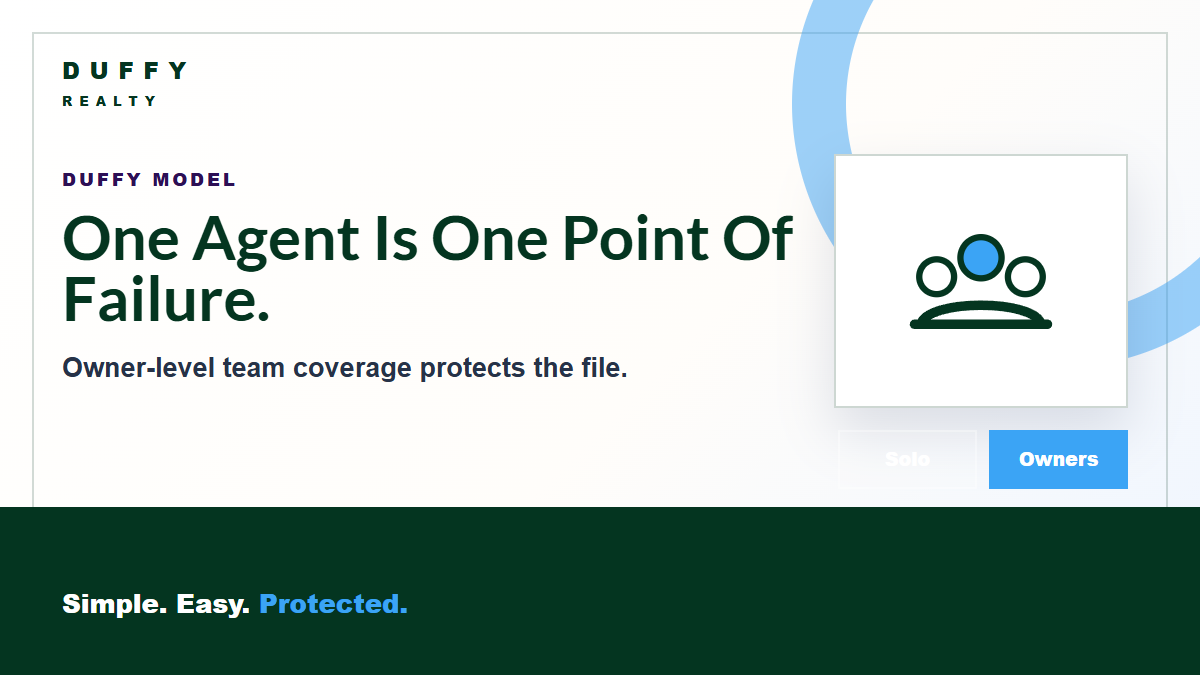
One-agent brokerages have a single point of failure: the agent. If they’re on vacation, sick, or juggling 40 deals, your transaction suffers. Here’s why DUFFY’s team model protects you differently.
This is not a personality flaw of solo agents. It’s a structural reality. The single-agent model has a built-in single point of failure: the agent.
DUFFY is built differently. Six owner-agents, all fully licensed, all cross-trained on every active file, all empowered to make decisions on your behalf. When one owner is unavailable, three others know your transaction by name. That’s not a marketing claim — that’s the operating system.
The Lone-Agent Model’s Built-In Flaws
Walk through a typical solo-agent transaction and count the points where one person’s bandwidth becomes your problem.
Day 5, the buyer’s inspector finds three issues. The listing agent is in a closing in Augusta. The buyer’s agent emails the response request and says “by tomorrow.” Solo agent doesn’t see the email until 9 PM. Negotiation slips a day. Buyer feels neglected.
Day 12, the appraiser calls with questions. Solo agent is showing five other houses to a relocating buyer all afternoon. Voicemail. Appraiser moves on. Appraisal report is finalized at the lower comp without your context. You lose $8,000 you didn’t have to lose.
DUFFY makes the decision sharper.
The same rule applies on both sides: understand the money, contract, timing, and risk before pressure starts making decisions for you.
Day 19, your contract attorney sends three time-sensitive questions about the title. Solo agent is at their kid’s soccer game. Reasonable life. Bad timing.
Multiply across thousands of transactions and you see the pattern: solo agents are heroic, hard-working, and completely overwhelmed. Their best work happens when nothing else is happening. Their worst work happens when everything is happening at once — which is exactly when your deal needs them most.
What Cross-Training Actually Means
“Team” is a word that’s been diluted in real estate. Some “teams” are actually one agent with a marketing assistant and an unlicensed showing partner. That’s not a team — that’s a solo agent in a costume.
Cross-training, the way DUFFY does it, means every active client file is reviewable, actionable, and owned by multiple licensed agents at the same time. The notes are shared. The history is in the system. The next steps are documented. Anyone can pick up the phone and continue the conversation seamlessly.
It also means every owner runs the full lifecycle — listings, buyer side, contract negotiation, closing coordination. Nobody specializes in just one phase. The agent who took your initial call can handle your contract negotiation can handle your closing. So can three of their colleagues. That’s redundancy by design.
Why 6 Owners Beat 1 Agent
There are six owner-agents at DUFFY Realty. Six is not arbitrary — it’s the number that allows full coverage, real specialization within a generalist framework, and meaningful overlap on every active file. With six people, no single owner is the bottleneck for anyone’s transaction.
The math: a solo agent with 40 active files is giving each file roughly 2% of their attention at any moment. A six-owner team with 240 active files (40 per owner equivalent) gives every file roughly 12% of attention because three or four owners are aware of every transaction. The buyer who calls the office at 4 PM on a Wednesday gets a real answer from someone who knows their file — not voicemail from the one person who happens to own that lead.
More importantly: when something goes wrong — and in real estate something always goes wrong — the response time is hours, not days. The wrong appraisal, the buyer’s loan delay, the seller’s last-minute hesitation. DUFFY clients almost never wait for a single agent to come back from anything. Someone is always paying attention.
The Handoff Protocol
When a client engages DUFFY, they’re introduced to their primary owner-agent and at least two backup owners by name. Not a team — specific people, specific names, specific cell numbers. The primary handles most communication. The backups know the file in real time and can step in without a 30-minute briefing call.
Every file has a daily snapshot updated in our internal system: where the transaction stands, what the next action is, who’s responsible, when it’s due. Any owner can open that file, read 90 seconds of context, and act. There’s no “let me find your agent” delay. There’s no “your agent will call you back” voicemail. There’s only the next action.
Vacation? Sickness? Family emergency? Out of cell range? None of those become your problem. They become a hand-off — a 5-minute phone call between owners that you never even see. The transaction continues at the same speed and quality. That’s the design.
Real Client Impact
Across 57,000 closings since 2002, the DUFFY ownership model has produced patterns we can predict. Average response time on time-sensitive client questions: under 45 minutes during business hours, under 4 hours after hours. Compare to industry benchmarks where solo-agent response times routinely run 4-24 hours.
Closing-day surprises — the calls about a missing document, an unexpected fee, a last-minute title issue — happen at every brokerage. The difference at DUFFY is that when those calls happen, three owners have eyes on the file before lunch. The fix happens in hours. We’ve watched solo-agent transactions get derailed by a Friday afternoon issue that didn’t get resolved until Tuesday because the agent was out. We don’t have those Tuesdays.
Real estate is not a job that can be done well by one person handling 40 transactions. The math doesn’t work. The hours don’t work. The client experience doesn’t work. The DUFFY model isn’t unusual because we have a team — most of the industry has “teams” now. It’s unusual because we have six owners. People who don’t get reassigned, don’t quit, don’t disappear. People who own the company. People whose names are on the door.
When you’re trusting someone with the largest financial transaction of your life, the question isn’t “is my agent good?” The question is “what happens when my agent is unavailable?” If the answer is “we wait,” you have a problem. If the answer is “three people who own the company step in,” you have DUFFY.
Quick Answers
(These are formatted as FAQPage schema in JSON-LD on the live page.)
What’s the difference between a team and a solo agent?
A solo agent works your transaction alone — every call, every email, every showing, every negotiation goes through one person. A team distributes work across multiple licensed agents, but team structures vary wildly. Some teams are essentially one top producer with administrative support. Others are genuinely cross-trained groups where multiple licensed agents share active files. The key questions to ask: how many licensed agents will know my file? Who covers when my primary agent is unavailable? Do all team members have authority to make decisions on my behalf?
Does DUFFY have one agent or a team?
DUFFY Realty is a team of six owner-agents. Each client is introduced to a primary owner who handles day-to-day communication, plus at least two backup owners who know the file in real time and can step in immediately. All six owners are fully licensed, fully cross-trained on every phase of the transaction (listing, buyer-side, contract, closing), and have authority to act on your behalf. Vacations, illness, and bandwidth do not stall DUFFY transactions because three or four owners are always aware of every active file.
What is a cross-trained real estate team?
A cross-trained team is one where every member can handle every phase of a transaction — listing presentations, buyer representation, contract negotiation, inspection objections, appraisal disputes, closing coordination — rather than specializing in just one role. The advantage is redundancy: when one team member is unavailable, the next can pick up without a steep learning curve. Cross-training is rare in real estate because it requires sustained training investment, but it produces materially better client response times and lower transaction risk.
PRODUCTION NOTES
Image concept: Illustration: solo agent juggling 40 balls vs. 6-person team each holding a clearly defined role
Internal links to insert: /how-your-sale-is-managed-at-duffy/ | /real-estate-discount-brokers-atlanta/
Schema to deploy: FAQPage • Organization (with multiple founder/owner sub-entities) • Article • RealEstateAgent • Service
Keep inspecting the DUFFY standard.
Before you pay more, inspect what DUFFY built: protection, proof, strategy, and a simpler path from first question to closing.
Quick Answers
What’s the difference between a team and a solo agent?
A solo agent is one person. A team can give clients more coverage, cross-training, and fewer single points of failure when the transaction needs attention.
Does DUFFY have one agent or a team?
DUFFY is a team model with owner-level oversight. The people who built the system are watching the transaction, not just one person trying to carry everything alone.
What is a cross-trained real estate team?
A cross-trained real estate team means multiple trained people understand the process, files, deadlines, and standards so the client is not dependent on one person’s memory or availability.
Ready to move from reading to strategy?
Call us, talk it out, or start the form. We built this for people who value money, sanity, and time.