
Sellers / The Duffy Model / DUFFY Take
The word "discount" implies something was removed. Nothing was removed from DUFFY’s listing process — the inefficiency was. Here’s what the traditional 3% was actually paying for.
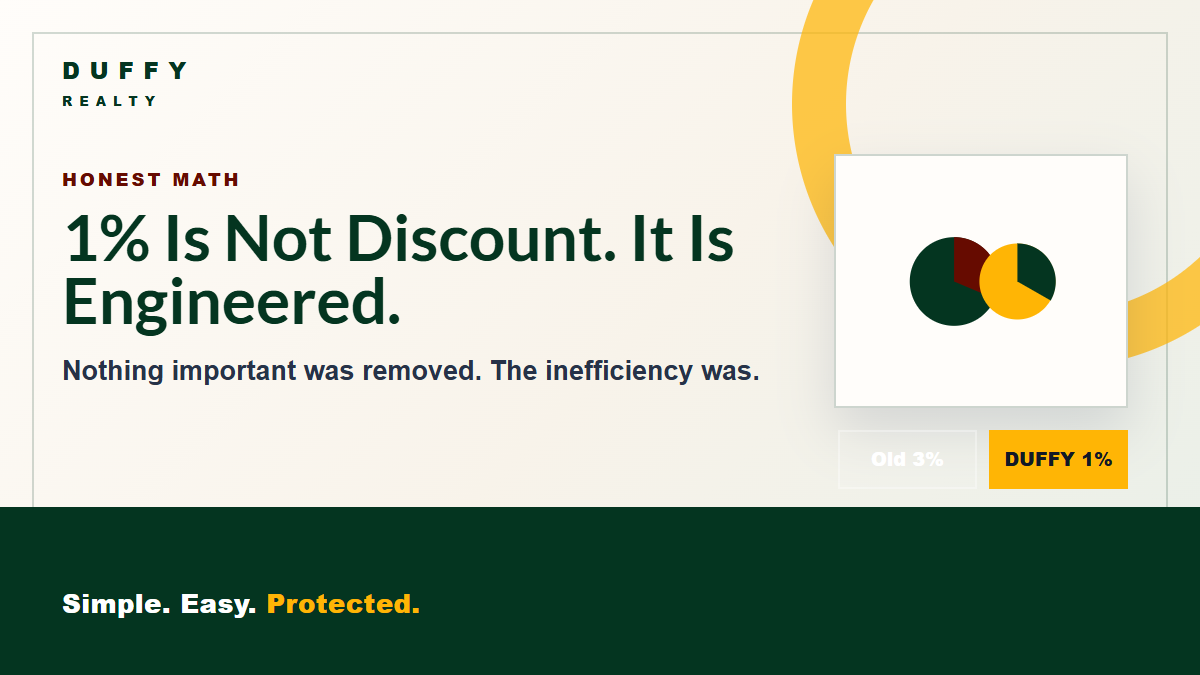
The word ‘discount’ implies something was removed. Nothing was removed from DUFFY’s listing process — the inefficiency was. Here’s what the traditional 3% was actually paying for.
The first thing most sellers ask when they hear about a 1% listing commission is reasonable: "What am I giving up?"
It is the right question. The answer surprises people. Sellers expect to hear that they’re trading service for savings — fewer agent visits, less marketing, weaker negotiation, slower response times. None of that is true at DUFFY. We list in two MLS systems instead of one. We use professional photography. We handle every step of contract management, negotiation, inspection, and closing coordination. We have closed tens of thousands of Atlanta transactions across every price point with this exact model.
What we removed wasn’t service. It was inefficiency. And once you understand where the traditional 3% was actually going — what work it duplicated, what overhead it carried, what failures it absorbed — the question flips. The real question isn’t "what does 1% give up?" It’s "what was the other 2% ever actually paying for?"
Where the 3% Number Came From (Historical Context)
The 6% total commission split — 3% to the listing agent, 3% to the buyer’s agent — is not a law. It is not a regulation. It is not based on any analysis of what residential real estate work actually costs. It is a convention that emerged in the 1950s and 1960s, when residential real estate was a far less efficient industry than it is today.
In that era, 3% to the listing agent reflected a real workload. The agent had to physically advertise the property — newspaper ads, printed brochures, MLS books distributed to other agents in physical binders. They had to coordinate showings by phone with no automated systems. They had to maintain a stable of buyer leads through manual networking because there was no online inventory search. The 3% paid for genuine, time-intensive labor that no longer exists in the same form.
DUFFY makes this simpler.
If you are selling, this is where DUFFY gets useful: pricing, value details, syndication, negotiation, contract review, and a 1% listing fee.
The number stuck around long after the labor that justified it disappeared. By the 2000s and 2010s, technology had absorbed most of the manual work, but the commission structure didn’t adjust. The result was an industry collecting 1950s pricing for 2020s workflows. That gap — between what the work actually requires and what the price still charges — is the inefficiency DUFFY removed.
What That 3% Was Paying For
Traditional 3% listing commissions absorbed several kinds of cost that have nothing to do with selling your specific home. Understanding them clarifies what you’re actually being charged for in a conventional listing arrangement.
Cross-subsidy of failed listings. The traditional model assumes a percentage of listings won’t sell. The agent’s commission on the listings that do close has to absorb the time spent on the ones that don’t. Your sale was paying for someone else’s failed listing.
Brokerage overhead and franchise fees. National brand brokerages pass corporate overhead, marketing co-op fees, franchise royalties, and regional administrative costs onto each transaction. A meaningful share of the 3% never reached the agent doing the work.
Manual processes that have been automated. MLS submission, showing coordination, document handling, and marketing distribution were once labor-intensive. Today they’re largely automated, but the pricing didn’t adjust.
Solo-agent inefficiency. A traditional listing typically rests on one agent who does everything — pricing, marketing, showings, negotiation, contract management. The cost of that single point of failure, including the agent’s time on tasks better handled by specialists, is built into the commission.
Margin for sales-driven competition. Traditional brokerages compete primarily by recruiting top-producing agents with promises of higher commission splits. That competitive structure inflates costs throughout the system, and clients pay for it.
What DUFFY Engineered Out
When we built the DUFFY model in 2002, we designed it to remove the inefficiencies — not to remove service. The result is a structure that does the same essential work for a fraction of the price.
We engineered out the cross-subsidy by being highly selective and consistent in how we list and price homes. We engineered out the overhead by operating as an Employee Stock Ownership company without the franchise fees, regional layers, or corporate marketing co-ops that traditional brokerages absorb. We engineered out the manual processes by building proprietary systems for showing coordination, contract tracking, and seller communication. We engineered out the solo-agent failure point by structuring the business as a team where six owners and seven specialists each handle the parts of a transaction they’re best at.
The traditional 3% wasn’t paying for better service. It was paying for a less efficient operating model. DUFFY’s 1% reflects the actual work in 2026 — accurately priced, professionally executed, and engineered for clients who would rather keep the difference than fund someone else’s overhead.
What the 1% Still Covers
Sellers sometimes assume that a lower commission means a thinner service. The DUFFY 1% covers the full scope of a professional listing:
Comparative market analysis and pricing strategy with adjustment math, not vibes.
Listing in two MLS systems (FMLS and GAMLS), not one — because half the Atlanta agent and buyer pool searches each.
Syndication to all major real estate portals — Zillow, Realtor.com, Redfin, and the rest.
Professional photography with intentional sequencing and the option of drone or twilight shots.
Listing description, marketing copy, and online positioning across the major search platforms.
Showing coordination through automated lockbox and showing systems used by every major Atlanta brokerage.
Full negotiation, offer evaluation, and counter-offer management.
DUFFY’s proprietary protection timeline tracking every contract deadline, contingency, and deliverable.
Contract-to-close management including title, survey, inspection, financing, and closing coordination.
Direct access to a full team of specialists rather than dependence on a single agent’s availability.
What you don’t get is what the traditional 3% was actually charging extra for: a sales presentation in your living room, brand-name franchise overhead, and the financial buffer for the listings that quietly didn’t sell at other firms.
The Math Side-by-Side
Here is the practical impact for an Atlanta seller. On a $500,000 home, the listing-side commission alone is $5,000 with DUFFY versus $15,000 with a traditional 3% listing — a $10,000 difference that goes directly into the seller’s pocket at closing. On a $750,000 home, the difference is $15,000. On a $1,000,000 home, $20,000.
These aren’t theoretical numbers. They are what tens of thousands of Atlanta sellers have actually saved with DUFFY since 2002 — savings that totaled into the tens of millions of dollars long before we updated our public reporting.
The savings don’t come at the cost of sale price. DUFFY listings consistently sell for the same percentage of list price as comparable traditional listings, frequently closer to original asking, because the same MLS, same buyers, same pricing discipline, and same contract protection apply. The savings come from the listing-side commission alone, where the inefficiency lived.
If you want to see the program structure in detail, our DUFFY 1% listing commission page lays it out, and our broader piece on real estate discount brokers Atlanta explains how to evaluate any low-commission brokerage including ours.
1% is not a discount. It is what the work costs when nothing is wasted. The 2% you save isn’t a corner being cut. It’s a corner that was never necessary in the first place.
Quick Answers
What’s included in DUFFY’s 1% listing fee?
The 1% includes comparative market analysis and pricing strategy, listing in both FMLS and GAMLS, syndication to all major portals, professional photography, listing copy, showing coordination, full negotiation, contract-to-close management, and DUFFY’s proprietary protection timeline tracking every deadline. The same essential services as a traditional listing — without the franchise overhead and inefficiencies that drove traditional commissions to 3%.
Why is DUFFY’s commission lower?
DUFFY engineered out the inefficiencies that drove traditional commissions, including cross-subsidy of failed listings, franchise and corporate overhead, manual processes that have been automated, and the solo-agent operating structure. By operating as an Employee Stock Ownership company with a team-based specialist model, we deliver the same essential listing service at a fraction of the cost — with the savings flowing to the seller, not to overhead.
Does a 1% listing mean less service?
No. DUFFY listings receive professional photography, dual-MLS exposure, full marketing syndication, showing coordination, negotiation, contract management, and a proprietary deadline-tracking system used by every DUFFY transaction. Across tens of thousands of Atlanta closings since 2002, DUFFY listings have sold at comparable percentages of list price to traditional listings — proving the lower commission reflects efficiency, not reduced service.
Keep inspecting the DUFFY standard.
Before you pay more, inspect what DUFFY built: protection, proof, strategy, and a simpler path from first question to closing.
Quick Answers
What’s included in DUFFY’s 1% listing fee?
DUFFY’s 1% listing fee includes strategy, listing exposure through the two multiple listing services in Atlanta, professional presentation guidance, offer review, negotiation support, contract protection, and closing coordination.
Why is DUFFY’s commission lower?
DUFFY engineered out inefficiency, not service. The model is built around team process, technology, owner oversight, and a belief that full service should not require old commission math.
Does a 1% listing mean less service?
No. A 1% listing fee at DUFFY does not mean less exposure or less protection. It means the system was built differently.
Ready to move from reading to strategy?
Call us, talk it out, or start the form. We built this for people who value money, sanity, and time.